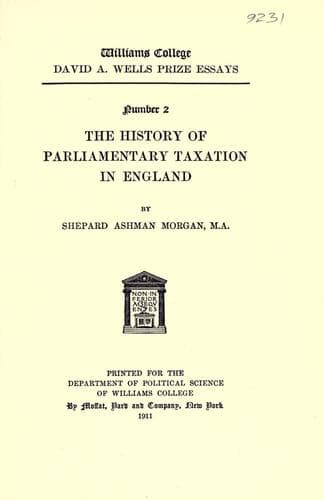
The History of Parliamentary Taxation in EnglandMorgan, Shepard Ashman
History
The History of Parliamentary Taxation in England
Morgan, Shepard Ashman
Taxation -- Great Britain; Taxation -- Great Britain -- History
[Edward III, 1327-1377]
The reign of Edward III dates from the 24th January, 1327. He was
crowned five days later at the age of fourteen and took the same
stringent oath as that which had failed to bind his father. Parliament
appointed a council of government which was to be in constant
attendance upon the king; but the queen and her familiar, Mortimer,
assumed so dominant a control over the young king that the influence
of the Council was nil. Edward went through the formality of confirming
the charters and forbidding illegal assessment of aids. His rule really
did not begin until November, 1330, when Mortimer was killed.
Edward III, being no statesman, but a warrior, energetic, without
scruple, lavish, and ambitious, was not a figure designed to loom
large in constitutional history. He did not mould events as did his
grandfather; he watched them move. As a matter of fact there was
advance. Tallage was prohibited and there came, too, the abolition in
law of other forms of arbitrary taxation.
[Tallage of 1332 and its withdrawal]
Edward had in mind in 1332 the reduction of Scotland.[209] To that end
he revived a financial expedient which had not been exercised since
his father’s embarrassment in 1312, and tallaged the demesne cities
and boroughs, and the rural demesne. On the 25th June, he sent out
orders for the collection of a fourteenth of movables and a ninth of
rents.[210]
Parliament met three months later, on the 9th September, and a request
formulated by the prelates, earls, barons, and the knights of the
shires, was addressed to the king praying the recall of the commission
for the tallage; Parliament offered as a substitute a fifteenth from
the shires and a tenth from the towns. Just why a Parliament in which
the Rolls do not note the inclusion of the burgesses should accomplish
such a substitution, which obviously benefited the townsmen, is not
clear, unless a considerable portion of the knights dwelt within the
royal demesne or in small towns formerly subjected to the exaction of
tallage. In his acceptance of the grant Edward promised for the future
that he would not lay such a tallage, “Except as was customary in the
time of our ancestors, and as he might rightly do.”[211] It was not,
however, until the sweeping legislation of 1340 that tallage became
illegal.
[New Customs become a regular means of revenue]
In parallel to the struggle against tallaging the royal demesne was the
contest with the king in the matter of the custom on wool. Edward in
1328 confirmed the reëstablished scale of 1322 which his father in his
hour of supremacy had laid upon the alien merchants, in amount equal to
the “nova custuma” of Edward I. From this time the New Customs became
a part of the regular revenue of the crown, though Parliament did not
yield its sanction until a time some fifty years after the first levy,
when, in 1353, it gave its assent to the Statute of Staples.
Public-domain text, read in full here on John Shaqi.
Reviews
Reviews
No reviews yet
Be the first to share your thoughts on this work.
Elsewhere in the archive
Join the Discussion
Join the discussion
Sign in to leave a comment or review.
Sign InorCreate an account