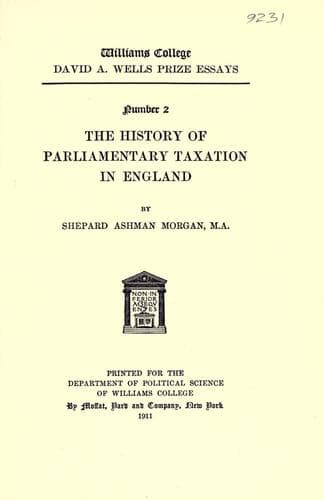
The History of Parliamentary Taxation in EnglandMorgan, Shepard Ashman
History
The History of Parliamentary Taxation in England
Morgan, Shepard Ashman
Taxation -- Great Britain; Taxation -- Great Britain -- History
Throughout the reigns of Edward II and Edward III a process of
differentiation had been going on within the walls of Parliament
itself, resulting in separate sessions of lords and commons. The
process had its beginnings, indeed, in the time of Edward I, yet no
instance can be pointed to with certainty showing the separate sessions
until 1332. In that year the Rolls of Parliament speak of distinct
assemblies. In 1339 the division appears to have become permanent. The
House of Commons in 1352 occupied the Chapter House of Westminster
Abbey.[242] The separate sessions of lords on the one hand and the
knights of the shires and the burgesses was the preliminary of the
assumption by the two latter bodies, in name the House of Commons, of
the power of initiating tax legislation.
[Richard II, 1377-1399]
Edward III left the throne to the keeping of a boy, his grandson, the
youthful Richard II. He was only eleven years old at the beginning of
his reign, and only thirty-three when his brief attempt at absolutism
brought him deposition, and then death. “The fair rose withered,” as
Shakespeare described his dethronement, but the withering was due to
the attempt of the king, ill-advised and perhaps insane, to climb too
high.
In the matter of taxation, however, the chief interest lies in the
early part of his reign, when the years of Richard’s minority gave the
commons opportunity to enforce the exercise of the principle that taxes
should not be levied without their consent, and to foster the theories
advanced in the previous reign that they had a right to examine the
public accounts and to appropriate supplies.
[Trouble over audit of accounts]
Public-domain text, read in full here on John Shaqi.
Reviews
Reviews
No reviews yet
Be the first to share your thoughts on this work.
Elsewhere in the archive
Join the Discussion
Join the discussion
Sign in to leave a comment or review.
Sign InorCreate an account