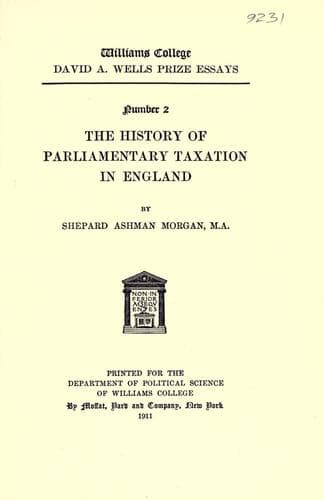
The History of Parliamentary Taxation in EnglandMorgan, Shepard Ashman
History
The History of Parliamentary Taxation in England
Morgan, Shepard Ashman
Taxation -- Great Britain; Taxation -- Great Britain -- History
In the time of Richard II the examination of public accounts and the
granting of money for specific purposes, became national issues. At his
first Parliament, that of October, 1377, grants of two fifteenths and
tenths were made for the prosecution of the French war on the express
condition that two treasurers be appointed who should see to the due
application of the proceeds.[243] The king chose William Walworth and
John Philipot, merchants of London, the latter of whom is distinguished
as one of the earliest English financiers, and these swore to perform
their duties faithfully. It was not without difficulty, however, that
the next Parliament, which met in October, 1378, was able to secure
an accounting. The commons demanded the accounts and for a time the
chancellor attempted evasion, hoping, so it appears, to shield John
of Gaunt who was suspected of obtaining money from the treasurers for
his private purposes. He was forced to yield and the accounts were
laid open to criticism, though with the incidental assertion by the
king “that it had never been known that, of a subsidy or other grant
made to the king in Parliament or out of Parliament by the commons, an
account had afterwards been rendered to the commons or to any one else
except to the king and his officers.” More than that, there was to be
understanding “that this shall not in future be considered a precedent
or an inference that this should have been done otherwise than by the
personal volition and command alone of our said lord the king....”[244]
[Special treasurers]
Public-domain text, read in full here on John Shaqi.
Reviews
Reviews
No reviews yet
Be the first to share your thoughts on this work.
Elsewhere in the archive
Join the Discussion
Join the discussion
Sign in to leave a comment or review.
Sign InorCreate an account