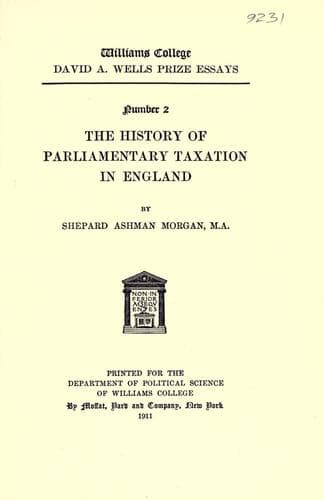
The History of Parliamentary Taxation in EnglandMorgan, Shepard Ashman
History
The History of Parliamentary Taxation in England
Morgan, Shepard Ashman
Taxation -- Great Britain; Taxation -- Great Britain -- History
It was in 991[4] that the Saxon army under Brihtnoth, Ealdorman of the
East Saxons, suffered decisive defeat at the hands of Danish pirates.
King Ethelred the Unready found himself at the mercy of foreign
enemies, and his only recourse was bribery. Under this necessity, a
levy[5] of £10,000 was made, and secured momentary peace from the
truculent Danes. But it was only momentary; they returned in 994
and took away £16,000. They repeated, under various pretexts, their
profitable incursions in 1002, 1007, and 1011.[6] In 1012, having
been bought off for the last time, the Danes entered English pay,
and the Danegeld instead of being an extraordinary charge, became a
regularly recurrent tax. It continued until 1051, when Edward the
Confessor succeeded in paying off the last of the Danish ships.[7] The
chronicler[8] accounts for the abolition of the Danegeld after the
manner of his time. Edward the Confessor, so goes the story, entered
his treasure-house one day to find the Devil sitting amongst the money
bags. It so happened that the wealth which was being thus guarded was
that which had accrued from a recent levy of the Danegeld. To the pious
Confessor the sight was sufficient to demonstrate the evil of the tax
and he straightway abolished it.
[Authority for the Danegeld]
But the history of the origin of the Danegeld and the mythical tale of
its abolition are of trifling importance as compared with the authority
whereby the impost was laid. In 991 it was apparently the Witenagemot,
acting upon the advice of the Archbishop Sigeric, which issued the
decree levying the tax.[9] Three years later it was “King Ethelred
by the advice of his chief men” who promised the Danes tribute.[10]
Similarly in 1002, 1007, and 1011 it is Ethelred “cum consilio
primatum” who fixes the amount of money to be raised.[11]
The deduction is not hard to make: it was at least usual if indeed it
was not felt to be a necessity for the king to take counsel with the
Witenagemot before he went about the preliminaries of taxation. It
is not unlikely, however, that in practice the assent of the Witan
was less or more of a formality varying according to the weakness or
strength of the king. A strong king’s will would dominate the Witan,
whereas a weak king would be subservient to its desires and interest.
[The Witenagemot and its powers]
Public-domain text, read in full here on John Shaqi.
Reviews
Reviews
No reviews yet
Be the first to share your thoughts on this work.
Join the Discussion
Join the discussion
Sign in to leave a comment or review.
Sign InorCreate an account