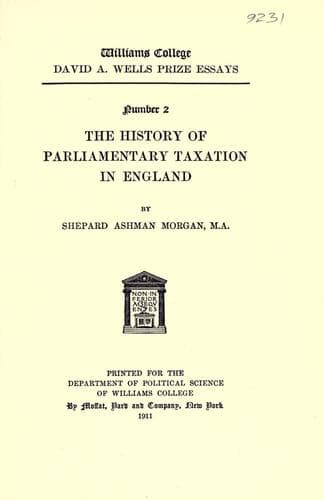
The History of Parliamentary Taxation in EnglandMorgan, Shepard Ashman
History
The History of Parliamentary Taxation in England
Morgan, Shepard Ashman
Taxation -- Great Britain; Taxation -- Great Britain -- History
In order to arrive at a clear comprehension of the taxing power of
the Witan as compared with that subsequently exercised by the English
Parliament, it is essential that one understands the make-up of the
Anglo-Saxon body. As its name implies, the Witan was an assembly
of the wise. Its organization was not based upon the ownership of
land, nor was there any rule held to undeviatingly which prescribed
qualifications for membership. Generally speaking it was composed of
the king and his family, who were known as the Athelings; the national
officers, both ecclesiastical and civil, a group which included the
bishops and abbots, the ealdormen or chief men of the shires, and
the ministri or administrative officers; and finally, the royal
nominees, men who are not comprehensible in the above classes, but who
recommended themselves to the king by reason of unusual or expert
knowlege.[12] It is observable, then, that this assembly was by the
nature of its composition aristocratic. That it was not representative
in the modern sense of the term is as readily apparent. With certain
restrictions the official members--the bishops, ealdormen, the
ministri--were coöpted by the existing members, while the remainder
were either present by right of birth or invited to attend by reason
of peculiar attainment. Nevertheless, the Witenagemot was commonly
believed to be capable of expressing the national will. It had the
power of electing the king and the complementary power of deposition,
and exercised every power of government, making laws, administering
them, adjudging cases arising under them, and levying taxes for the
public need.[13]
Such in brief was the body which in 991 assented to the levy of the
Danegeld. The act was of great importance; by it the Witan both
exercised a right which was not to be vindicated in its completeness
for the space of seven hundred years, but it laid a trap for those
who, in the time of Charles the First, should be struggling for the
attainment of that right, for in their action lay the precedent
which the Stuart lawyers should warp into a pretext for the levy of
ship-money.
II
FEUDAL AND ROYAL TAXATION
THE NORMAN AND THE ANGEVIN KINGS
1066-1215
[Character of the Norman Rule]
UNDER the Saxon kings the structure of government was only half built.
The foundation, laid in the shire and hundred moots, the townships, and
the incidental organisms of local government, was solid and capable
of upholding a heavy superstructure. But the Saxons scarcely built
further. They left to the Norman kings, peculiarly fitted to their
work by temperament and habit, the task of setting up a strong central
government. The price which the nation paid for it was the loss of what
right it had possessed of assenting to taxation.
Public-domain text, read in full here on John Shaqi.
Reviews
Reviews
No reviews yet
Be the first to share your thoughts on this work.
Join the Discussion
Join the discussion
Sign in to leave a comment or review.
Sign InorCreate an account