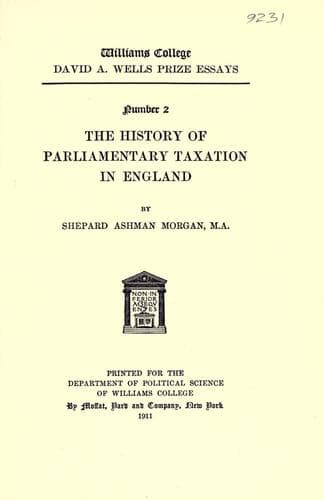
The History of Parliamentary Taxation in EnglandMorgan, Shepard Ashman
History
The History of Parliamentary Taxation in England
Morgan, Shepard Ashman
Taxation -- Great Britain; Taxation -- Great Britain -- History
Nevertheless, this same Parliament upon the occasion of its grant to
the king, petitioned that it be expended for the advantage of the
kingdom, and that competent treasurers be appointed to keep the
accounts.[245] The thirteen-year-old king readily fell in with the
idea. To the Parliament of 1379 he sent letters in which he said, “That
you may be fully informed of the real nature of the said necessary
expenditures made and to be made, the treasurers for the said war
shall be present and shall appear, at such hour as pleases you, to
show you clearly in writing their receipts and expenditures made since
the last Parliament.”[246] The House of Commons, later during the same
Parliament petitioned for the discharge of the special treasurers,
and prayed that the Treasurer of England with the Chamberlains of the
Exchequer receive money as “was usual of old.”[247] Here is an early
instance of the individual action of the House of Commons. But in
1380, the tide turned back. The commons who were assuming leadership
in the situation, hearing from the chancellor of the very serious
embarrassment in which the crown found itself, were stung to the
belief that there was extravagance in the royal household, or else
that the ministers were incapable. They therefore prayed the king
to allow the election in Parliament of the chief officers of state.
Richard responded favorably and the commission was appointed, with
the old treasurers of subsidies, William Walworth and John Philipot,
as members.[248] By 1382 the reversion to the system of special
treasurers was complete,[249] and from that time, save at moments of
great national confusion, these officers were regularly appointed and
had as their duties the keeping of accounts, both of income and outlay,
which were to be presented before Parliament at its session immediately
following.
[Taxation by Parliament]
Over the levy of taxes Parliament, so it appears, had unquestioned
control throughout the reign;[250] the king’s household was vastly
extravagant and the royal prerogative of purveyance was exercised to
excess, but even in the articles of deposition no word of complaint,
save in the most general terms, is levelled at the king for laying
taxes unlawfully, and this remonstrance is unsupported by specific
instances. Indeed, the most violent outbreak on the score of taxation
was against Parliament itself.
Public-domain text, read in full here on John Shaqi.
Reviews
Reviews
No reviews yet
Be the first to share your thoughts on this work.
Elsewhere in the archive
Join the Discussion
Join the discussion
Sign in to leave a comment or review.
Sign InorCreate an account