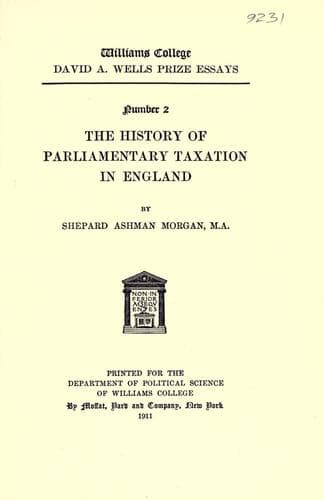
The History of Parliamentary Taxation in EnglandMorgan, Shepard Ashman
History
The History of Parliamentary Taxation in England
Morgan, Shepard Ashman
Taxation -- Great Britain; Taxation -- Great Britain -- History
In 1380, Parliament found itself in this difficult position, that
it was under necessity of supplying an immensely large sum, no less
than £160,000, as speedily as possible. The French war, an expedition
about to be undertaken against Scotland, and the usual expenses of
the kingdom had so depleted the royal treasury that the king was
sorely embarrassed; he was greatly in debt and his jewels were already
pawned. The commons were at a loss to devise the means whereby so
great a sum could be raised, and showed a disposition to shirk the
burden. The lords undertook it and suggested three methods: a graduated
poll-tax, a custom on merchandise, or a number of fifteenths and
tenths. The commons, seeing in the first the virtue of rapid assessment
and collection, chose it in spite of the disappointing proceeds of
the poll-tax of two years previously. A subsidy on wool, the normal
income from which would amount to £60,000, was to serve as an
auxiliary tax. The clergy undertook to raise a third of the remaining
£100,000, leaving some £66,667 to accrue from the poll-tax. The rate
varied according to individuals from sixty groats to three, with an
understanding that the rich should help the poor, but that in no case
should a man pay less than a groat for himself and his wife.[251]
[The Rising of the Villeins]
Here was the exciting cause for the Rising of the Villeins which
Bishop Stubbs describes as “one of the most portentous phenomena to
be found in the whole of our history.”[252] Following closely as did
the poll-tax of 1380 upon those of 1378 and 1379, both of which bore
heavily upon the lesser people, the impost set fire to tinder which had
been long preparing for a conflagration. To enter into an inquiry as
to the underlying causes and the ultimate consequences of this rising,
would be to travel far afield. It is sufficient to observe that the
payment of even so small a sum as a groat, served to bring freshly to
the minds of the most ignorant the maladministration in London, and
to arouse in them the impulse, however ill-advised or ill-directed,
to correct abuses in the executive. The Rising of the Villeins is
illustrative of the not unusual conception that bad government is
chiefly reprehensible because it is expensive.
The taxation during the years 1389-1397 was regular and moderate.
Richard’s rule for the time was that of a constitutional monarch and
his Parliaments exercised the power of initiating taxation without
opposition. Parliament was practicing what it had accomplished in
theory in the long years of struggle since Magna Carta; it was
accustoming itself to the exercise of the powers which in principle it
had acquired. Fulfillment in fact was following upon enunciation of
principle. Consequently it was with the greater shock to the nation
that Richard II suddenly changed from his constitutional habit and took
upon himself the powers of a despot.
[Richard’s despotism and his dethronement]
Public-domain text, read in full here on John Shaqi.
Reviews
Reviews
No reviews yet
Be the first to share your thoughts on this work.
Elsewhere in the archive
Join the Discussion
Join the discussion
Sign in to leave a comment or review.
Sign InorCreate an account