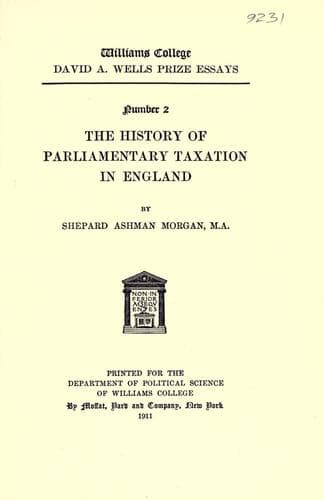
The History of Parliamentary Taxation in EnglandMorgan, Shepard Ashman
History
The History of Parliamentary Taxation in England
Morgan, Shepard Ashman
Taxation -- Great Britain; Taxation -- Great Britain -- History
The temptation came to him as a result of the action of Parliament
itself. In 1398, following upon its grant the previous year, of a
custom on wool for five years and tunnage and poundage for three
years, it granted the subsidy on wool, woolfells, and leather
to Richard for the space of his life. Beside this unprecedented
liberality, it gave him as well a tenth and a half and a fifteenth and
a half for the curious term of a year and a half.[253] Nor was this
all. It cut off its own head by delegating its authority to a standing
committee of Parliament. The opening was barely offered before Richard
took advantage of it. With a revenue for life and a Council subservient
to his will, scarcely ever was there better chance for despotism; but
the acceptance of the opportunity was the close forerunner of disaster.
With the idea in his head that all was safe in England, Richard went
off to Ireland. This gave Henry, the heir to the dukedom of Lancaster,
a dream of an unguarded throne to which he could climb. Estranged by
reason of his disinheritance, he was ready to act as soon as he saw
such a vision. He landed in Yorkshire, moved southward, receiving
allegiance of the people as he went, and won away from Richard the
powerful supporters of the throne. Richard, returning, fought a battle
already lost. He resigned his kingship, and the nation as represented
in Parliament, accepted his resignation.
The charges against the king, upon which sentence of deposition was
pronounced, were summed up in thirty-three articles. Only four of them
in any degree concern taxation. These are: (14) he had not repaid loans
made in dependence upon his solemn promise; (15) he had alienated the
crown estates, and exacted unlawful taxes and purveyances; (19) he had
tampered with the elections by nominating the knights whom the sheriffs
were to return, in order to ensure to himself a revenue for life;
(21) he had extorted money from seventeen whole shires for pretended
pardons.[254]
Public-domain text, read in full here on John Shaqi.
Reviews
Reviews
No reviews yet
Be the first to share your thoughts on this work.
Elsewhere in the archive
Join the Discussion
Join the discussion
Sign in to leave a comment or review.
Sign InorCreate an account