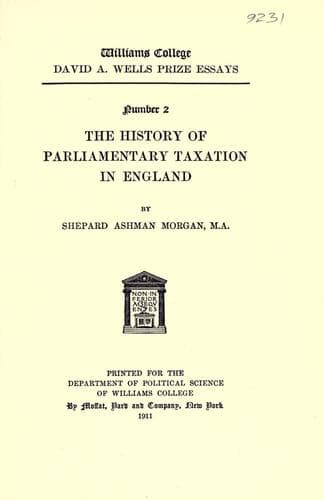
The History of Parliamentary Taxation in EnglandMorgan, Shepard Ashman
History
The History of Parliamentary Taxation in England
Morgan, Shepard Ashman
Taxation -- Great Britain; Taxation -- Great Britain -- History
The charges were doubtless colored by enthusiasm for his deposition.
The most serious, that of unlawful taxation, seems difficult to
substantiate unless it be taken in connection with the article which
asserts that the Parliament of 1398 was packed for the very purpose of
securing a revenue for life. The complaint against purveyance seems
equally ill-founded; during the reign of Edward III it had assumed the
proportions of a great abuse of prerogative, but it was not in the time
of his grandson an object of great concern to the nation. Thomas of
Walsingham, whose tone is somewhat querulous, gives substance to the
charges about the nonpayment of loans and the exaction of money for
pretended pardons. “Promising in good faith to repay,” he says, “he
never after gave the money back to his creditors.” Further, “The clergy
and the common people and the temporal lords were constrained to give
the king sums of money beyond the strength of man to bear, in order to
buy back his good will.”[255] The step was very short to the forced
loans of the Tudors.
The trouble with Richard was that he did not go to school to history.
Parliament was putting into practice what it could learn from the
experience of its predecessors. Richard, swept with a desire, intense
and perhaps insane, to wield the sceptre of absolutism, was blinded to
what he might have read, and underwent the consequences.
[Henry IV, 1399-1413]
Henry IV was better advised; at any rate, he was politic enough to live
closely by what he had learned. He was suspicious, cautious, slow and
faltering in action save in the one supreme instance of seizing the
throne; an exceedingly good politician. The power of Parliament and
especially of the commons during his reign was more complete than ever
before,--fuller, indeed, than it should be again until after the final
hand-to-hand struggle with the Stuarts. In the matter of taxation,
instances of illegality are rare; Parliament continued to exercise the
supreme control in voting taxes; and in the more recently acquired
rights of appropriating supplies and examining public accounts, the
supremacy of Parliament was established. Not only does this observation
hold good during the reign of Henry IV, but it is equally applicable to
the two Lancastrians who succeeded him.
In 1400 there appears to have been an exception to this rule. Henry
apparently secured an aid not from Parliament but from the Great
Council. There was the understanding, however, that the grant was
binding not upon the nation at large but upon the members of the
Council.
[Practice of delaying grants]
Public-domain text, read in full here on John Shaqi.
Reviews
Reviews
No reviews yet
Be the first to share your thoughts on this work.
Elsewhere in the archive
Join the Discussion
Join the discussion
Sign in to leave a comment or review.
Sign InorCreate an account