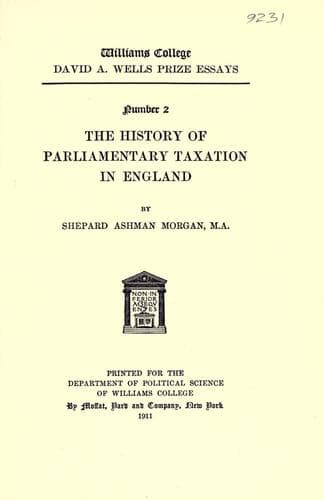
The History of Parliamentary Taxation in EnglandMorgan, Shepard Ashman
History
The History of Parliamentary Taxation in England
Morgan, Shepard Ashman
Taxation -- Great Britain; Taxation -- Great Britain -- History
In 1401 the commons attempted to make dependence of supply upon
redress of grievances a part of the regular parliamentary procedure.
They prayed the king that they know his responses to petitions before
setting themselves to the business of granting a supply. Henry met the
issue squarely. “On the last day of the Parliament,” say the Rolls,
“response was made that this manner of deed had not been seen nor used
in the time of any of his ancestors or predecessors, that they should
have any response to their petitions or knowledge of the same before
they had taken up and completed all the other business of Parliament,
be it to make any grant or otherwise. And therefore the king did not
wish in any way to change the good customs and usages made and used in
former times.”[256] Nevertheless, the commons proceeded to put into
practice the substance of their demand by delaying their grants of
supply until the last day of the session, when the most important of
the petitions would have received answers. Thus the next Parliament,
that which met on the 30th September, 1402, withheld its grant until
the 24th November; the session closed on the 25th and no business was
transacted in the meantime.
[Initiation of tax levies in the House of Commons, 1407]
The chief advance in the reign of the new king lay not in a fuller
control by Parliament in the matter of laying taxation; that would
scarcely have been possible. But it lay rather in a differentiation of
powers within Parliament itself, leading to a more complete supervision
of taxation by the House of Commons. Since the end of Edward III’s
reign the theory had been practiced that the commons should exercise a
decisive power over the levy of taxes, as illustrated in the levy of
the poll-tax of 1380.
The form of making a grant, “made by the commons with the assent of the
lords spiritual and temporal” first occurred in the grants to Richard
II in 1395.[257] Votes of money previous to that year were made in
conjunction with the House of Lords. The phrase was repeated in the
grants of 1401 and 1402.
In 1407 came the assertion that to the commons not only belonged
decisive power, but that they alone had the faculty of originating
taxation. It came not as a direct demand for the yielding of a
principle, but as an implication that the practice already existed, and
as such it gains in strength.
Public-domain text, read in full here on John Shaqi.
Reviews
Reviews
No reviews yet
Be the first to share your thoughts on this work.
Elsewhere in the archive
Join the Discussion
Join the discussion
Sign in to leave a comment or review.
Sign InorCreate an account