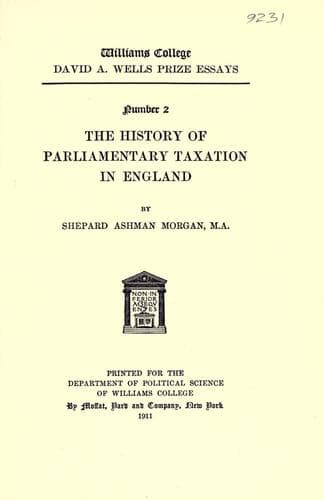
The History of Parliamentary Taxation in EnglandMorgan, Shepard Ashman
History
The History of Parliamentary Taxation in England
Morgan, Shepard Ashman
Taxation -- Great Britain; Taxation -- Great Britain -- History
The trend of events leading up to the significant reference is
interesting. In 1407 the lords had held a debate in the king’s presence
respecting the condition of the kingdom, and had determined upon the
number of subsidies needful for national defense. Henry, for the moment
forgetting his politics, in a peremptory tone requested the commons
to send a delegation to the House of Lords “to hear and to report to
their companions that which they should have in command of our lord
the king.” The commons sent a committee of twelve in response to the
request; they heard that “it was the will of our said lord the King
they should report to the rest of their companions” the determination
of the lords, and that, “they should see to it that they conformed
most nearly to the purpose of the Lords aforesaid.” When the delegates
returned, their report was received by the commons as being an
infringement upon their liberties. The king, hearing of the temper
of the commons, reassuming immediately his habit of the politician,
“declares, by the advice and consent of the lords in manner following,”
that it is lawful for both houses to commune apart by themselves “of
the state of the realm and of the remedy necessary for the same.” So
far the king has merely recognized the need for separate deliberations
by the two houses; the phrase which implies the existence in the House
of Commons of the power to initiate taxation is this: “Any grant by the
commons granted, and by the lords assented to.”[258] Thus is admitted
by implication the order in which a grant should be made by the two
houses. In the same communication the king renounces any right which
he might previously have held to know the amount or conditions of a
prospective grant until both houses should be of one mind. The grant
which eased so sweeping an admission from the king was generous.[259]
It consisted of a fifteenth and a half and a tenth and a half, a
subsidy on wool, and tunnage and poundage for two years.[260]
In 1410 Henry asked Parliament for permission to collect a tenth and a
fifteenth annually, whenever Parliament should not be sitting. Had the
request been granted, the result for a frugal monarch would have been
hardly less than independence of parliamentary control. He was refused.
Without the frequent necessity of calling a Parliament, Henry’s last
years, instead of their smooth constitutional trend, might readily have
had as tragic a story as those of Richard II. He died in 1413.
[Henry V, 1413-1422]
Public-domain text, read in full here on John Shaqi.
Reviews
Reviews
No reviews yet
Be the first to share your thoughts on this work.
Elsewhere in the archive
Join the Discussion
Join the discussion
Sign in to leave a comment or review.
Sign InorCreate an account