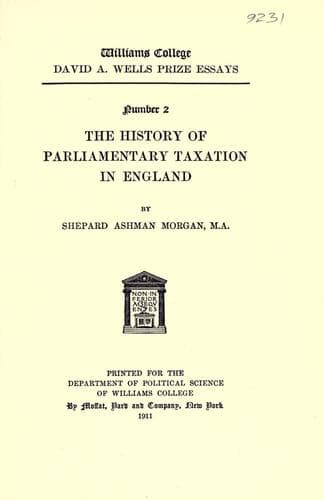
The History of Parliamentary Taxation in EnglandMorgan, Shepard Ashman
History
The History of Parliamentary Taxation in England
Morgan, Shepard Ashman
Taxation -- Great Britain; Taxation -- Great Britain -- History
His son Henry V came to the throne without dispute, and for a brief
nine years fired the souls of the English people with zest of conquest
and pride of race. A warrior, the mediæval ideal of a king, he was
yet noble of mind and soul. Had his brilliant career not so suddenly
flickered and gone out, he might have won a place beside Edward I; as
it was, the constitutional history of his reign reveals no struggle
between people and monarch over the sordid wherewithal to fight his
battles; both sides apparently honored the other. The taxation during
his reign was heavy, but it was voted gladly to the king who could use
it as a means to victory at Agincourt. Henry V, whom his people loved
enough to make legendary participant in their revellings, died in
France, 31st August, 1422.
[Henry VI, 1422-1461]
Henry VI was almost as unfortunate in his birth as in his death, and
his life seemed to bring him nothing but disaster. He was barely a
year old when his father died, his troubled reign saw the Wars of the
Roses, and tradition has it that he died by the hand of Richard, Duke
of Gloucester, afterward king. Weak in health, the possessor of a mind
which in boyhood showed the feverish precocity that foreshadows an
unbalanced maturity, he was nevertheless generous, temperate, mild, and
devoted.
[Declaration for appropriation of supplies]
The early part of his reign gives one of the few instances chronicled
under the Lancastrian kings of an attack upon constitutional usages
in taxation. In 1425 while the Duke of Bedford and Humfrey, Duke of
Gloucester were acting virtually as regents to their nephew the young
king, Bedford together with various other lords announced in Parliament
that a certain subsidy, which had been appropriated for a particular
purpose, should be levied for the king’s use notwithstanding the
conditions attaching to it; they advanced an opinion of the justices
favoring their action. The commons vindicated their right, however,
in the same Parliament; they made a fresh grant, restating the former
conditions, with this explicit addition, “No part thereof be beset ne
dispendid to no othir use, but oonly in and for the defense of the seid
roialme.”[261]
Public-domain text, read in full here on John Shaqi.
Reviews
Reviews
No reviews yet
Be the first to share your thoughts on this work.
Elsewhere in the archive
Join the Discussion
Join the discussion
Sign in to leave a comment or review.
Sign InorCreate an account