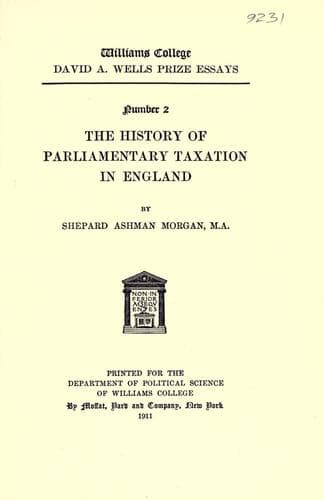
The History of Parliamentary Taxation in EnglandMorgan, Shepard Ashman
History
The History of Parliamentary Taxation in England
Morgan, Shepard Ashman
Taxation -- Great Britain; Taxation -- Great Britain -- History
It would be both wearisome and profitless to enter into a detailed
account of the various subsidies on wool, of income taxes, of
fifteenths and tenths which trod one on the heels of the other during
the reign of Henry VI. One incident of a constitutional character,
however, rises from the general regularity. In 1449, Parliament
attempted to levy a tax upon the stipendiary priests, though usage
had it that the clergy were to have the power of taxing themselves in
convocation; a subsidy of a noble was levied upon each stipendiary
priest, for which they were to receive a general pardon at the
hands of Parliament. Henry, perceiving that trouble was brewing,
addressed the clergy, saying that it was for them to make the grant in
convocation, and that it was for him to pardon. Thus Parliament, for
the moment overreaching itself, was forced back upon the justice of
precedent.[262]
[Accession of the Yorkists]
The wars with France and with Burgundy, the heavy taxation incident to
them, the rebellion of Jack Cade arising out of it, and the Wars of
the Roses in 1453 following closely thereafter; the woeful struggle of
Henry, bleached-out in mind, a dependent upon the efforts of a woman
against the rising power of York; the wanton shedding of the noblest
blood in England--these neither developed nor confirmed parliamentary
power. Edward of York, it is sufficient to understand, became king on
the 4th March, 1461, upon King Henry’s overthrow. A momentary turning
of the tide set him once more upon it, but his tenure was very brief
and ended in tragedy.
The passing of Henry VI brings us to the dawn of the Yorkist and Tudor
era. During the reigns of the son and grandson of Edward I and the
reigns of Richard II and the Lancastrians, Parliament had developed
swiftly, not so much in the assumption of new powers as in the
distribution of powers within itself. The commons became a separate
body. Burgesses learned to act in the House of Commons in concert with
knights of the shires who in the time of Edward I had made common cause
with the greater barons. Together they assumed the right of initiating
taxes, with the understanding that the hereditary chamber should have
solely the power of assent.
The right of Parliament as against that of the king to control taxation
was enunciated again and again, not only in the instance of direct
taxation, including the levies of tallage, but in the case of the
customs, as indicated in the legislation prohibiting the maletolt.
But the enunciation of powers of Parliament was not followed by
complete and undisputed exercise of the rights so enunciated. The kings
clung to what they deemed their ancient prerogatives and more than
once overstepped the law. The Yorkists and Tudors showed a disposition
somewhat less amenable.
VI
EXTRA-PARLIAMENTARY EXACTION 1461-1603
Public-domain text, read in full here on John Shaqi.
Reviews
Reviews
No reviews yet
Be the first to share your thoughts on this work.
Elsewhere in the archive
Join the Discussion
Join the discussion
Sign in to leave a comment or review.
Sign InorCreate an account