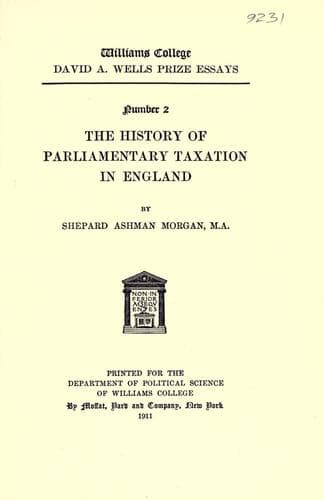
The History of Parliamentary Taxation in EnglandMorgan, Shepard Ashman
History
The History of Parliamentary Taxation in England
Morgan, Shepard Ashman
Taxation -- Great Britain; Taxation -- Great Britain -- History
Upon Edward’s death in 1483, the crown for a moment rested on the head
of his young son, Edward V, only to be snatched away in favor of the
lad’s uncle Richard III. Richard received from Parliament in 1484 a
grant of tunnage and poundage and the subsidy on wool for life.[265]
His death on Bosworth Field the next year gave the world no opportunity
to see what use he would make of the freedom which Parliament thus gave
him.
[Prohibition of benevolences, 1484]
During the brief three years of Richard’s ascendancy, however, there
occurred an assertion of right and its complementary statute which
assume great importance in the light of later events. When Richard was
invited to become king, he was presented with a remarkable address,
which, among other things, cited the benevolences of the late reign
as “extorcions, ... agenst the Lawes of God and Man,” and as more
intolerable than “jopardye of deth.”[266] At his only Parliament, held
in 1484, benevolences were declared unlawful, and were to be “dampned
and annulled forever.”[267]
[The Tudors]
Henry VII, the first of the Tudors, ascended the throne upon the
successful issue of the battle of Bosworth. The wonder of the era
which he introduced lies not in any increase in the powers of
Parliament, but rather that they existed at all when the period
closed. The one hundred and twenty years of the Tudor epoch exhibits
no progress toward the realization of parliamentary supremacy; on the
other hand, the trend was in the opposite direction. The Tudors were
not tyrannical enough to rouse opposition to the fever heat as did
John; they knew rather how to bridle their despotism in time to check
revolt, and especially how to make unlawful acts assume the aspect of
legality. Furthermore, the immense activity of commerce, the progress
of literature, the religious reconstitution during the sixteenth
century, were in themselves reasons for slow advance in matters of
government; the stress of trade consequent upon the discovery of a
new world, the absorbing interest in new subjects for thought, the
intensity and magnitude of new religious conceptions, engaged the minds
of men on subjects other than those of Parliament and king. As long
as these worked in apparent harmony and the results did not greatly
offend, men were content to let well enough alone. So it was that the
Tudors, surrounding themselves with a new nobility attached to the
throne by reasons of their very origin and continuance, were able to
follow their own devices and raise money almost as seemed to them good.
[Parliaments of Henry VII The “new-found” subsidy]
Public-domain text, read in full here on John Shaqi.
Reviews
Reviews
No reviews yet
Be the first to share your thoughts on this work.
Elsewhere in the archive
Join the Discussion
Join the discussion
Sign in to leave a comment or review.
Sign InorCreate an account