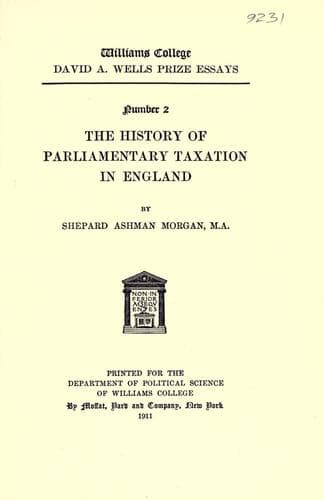
The History of Parliamentary Taxation in EnglandMorgan, Shepard Ashman
History
The History of Parliamentary Taxation in England
Morgan, Shepard Ashman
Taxation -- Great Britain; Taxation -- Great Britain -- History
In all the twenty-four years of Henry VII’s reign he called Parliament
only seven times, and six of the seven Parliaments sat within the first
eleven years of his kingship. Each was the occasion of a demand for
money. At his first Parliament, that of 1485, he received a grant of
tunnage and poundage and a subsidy on wool for life.[268] Three years
later, however, the consequences of heavy taxation were disastrous.
Need arising for the enlistment of an army with which to aid the Duke
of Brittany against the King of France, a tax was devised which not
only exacted a tenth of incomes from freeholders, but applied as well
to movables, laying imposition upon articles used in trade and even
merchants’ stocks. This “new-found subsidy” proved so intolerable to
the lower classes that a great insurrection broke out in the north
against it.[269] The king with Tudor wisdom, remitted some £48,000
of the £75,000 which the tax was designed to raise, and Parliament
gave him in return a fifteenth and tenth. In 1497, a similar rebellion
occurred in Cornwall against a tax levied for the Scotch War.
With these examples of parliamentary taxation before him, Henry turned
away to fields at once more profitable and less dangerous, at least in
their immediate consequences.
[Morton’s crotch]
He turned to the old expedient of the benevolence, despite the statute
of Richard III prohibiting its imposition. The methods used in laying
a benevolence are illustrated in the famous account by Lord Francis
Bacon of the dilemma devised by Bishop Morton, Henry’s Chancellor, “to
raise up the benevolence to a higher rate; and some called it his fork
and some his crotch. For he had couched an article in the instructions
to the commissioners who were to levy the benevolence, that if they
met with any that were sparing, they should tell them that they must
needs have, because they laid up; and if they were spenders, they must
needs have, because it was seen in their port and manner of living;
so neither kind came amiss.”[270] Parliament, subservient to the
king, actually registered for the moment its approval of the practice
of levying benevolences, when in 1492 it passed the “Shoring or
Under-propping Act” making debts still owing on gifts promised to the
king legally collectable.
The benevolence was not the only means by which the ingenious monarch
increased his income. Like Edward IV, he revived obsolete statutes and
rigorously exacted fines in consequence of every infraction of them;
but worse than that was his perversion of every function of the courts
of law into a means of extortion. His odious instruments in that work
were Richard Empson and Edmund Dudly who later were made to suffer for
the evil practices of the father in the reign of the son. Beside these
forms of imposition, the king pushed to the extreme the exaction of
feudal dues accruing to the crown.
[Henry VIII’s early taxation]
Public-domain text, read in full here on John Shaqi.
Reviews
Reviews
No reviews yet
Be the first to share your thoughts on this work.
Elsewhere in the archive
Join the Discussion
Join the discussion
Sign in to leave a comment or review.
Sign InorCreate an account