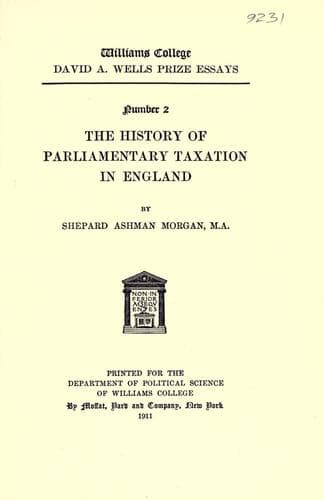
The History of Parliamentary Taxation in EnglandMorgan, Shepard Ashman
History
The History of Parliamentary Taxation in England
Morgan, Shepard Ashman
Taxation -- Great Britain; Taxation -- Great Britain -- History
Henry VIII succeeded to the crown in 1509. With his hand always on
the pulse of the nation, he knew when he could carry his designs into
execution and when he must wait for a fever to subside. His attitude
toward taxation was not characterized by the same uniform regard for
constitutional formalities that distinguished his other acts, nor was
Parliament on the other hand quite as subservient to his will as in
matters farther from their purses. His first Parliament showed its
trust in him by granting tunnage and poundage for life, but with the
distinct provision that it be not taken into precedent. Beside this,
the Parliaments of 1513 and 1514 made generous grants of a poll-tax,
of a fifteenth and tenth and of two subsidies of six pence in the
pound.[271] Despite the magnitude of the grant, no opposition seems to
have been provoked, an unfailing sign of increasing wealth.
[Cardinal Wolsey’s breach of privilege, 1523]
At the Parliament of 1523, the first since 1515, Cardinal Wolsey
committed a distinct breach of Parliamentary privilege. Under Henry IV
it had been admitted by the king that both houses of Parliament were
to commune apart, and that the king should have no knowledge of the
progress of a grant until the two houses be of one accord.[272] Wolsey,
as representative of the royal power, reversed the usual process. Going
into the House of Commons with all his following, “with his maces,
his pillars, his pole-axes, his cross, his hatte, and the great seale
too,”--in the words of the speaker, Sir Thomas More,--he asked for
no less than £800,000 and required that it be paid in four years; he
suggested that it “be raised out of the fifth part of every man’s goods
and lands.”
To the demand of the cardinal the commons maintained perfect silence.
The speaker “with many probable arguments endeavoured to shew the
cardinal that his manner of coming thither was neither expedient
nor agreeable to the ancient liberties of that House.”[273] Wolsey
thereupon departed in a rage. The next day the matter was argued by
the commons and the contention was made that “though some men were
well-monied, yet in general it was known that the fifth of men’s goods
was not in plate or money, but in stock and cattle. And that to pay
away all their coin would alter the whole frame and intercourse of
things.”[274] For fifteen days the commons debated the question and
at the end of that time granted to the king a graduated property tax,
much smaller in amount and covering four years in the payment. Wolsey’s
displeasure was very great and he made a second journey to the commons
in the hope that he might induce them to be more generous. He told them
that he “desired to reason with those who opposed his demands.” He
was answered that “it was the order of that House to hear, and not to
reason but amongst themselves.”[275] Thus rebuffed, the cardinal went
away.
[Henry’s commissions and benevolences]
Public-domain text, read in full here on John Shaqi.
Reviews
Reviews
No reviews yet
Be the first to share your thoughts on this work.
Elsewhere in the archive
Join the Discussion
Join the discussion
Sign in to leave a comment or review.
Sign InorCreate an account