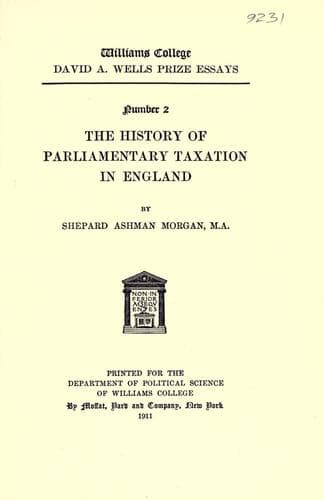
The History of Parliamentary Taxation in EnglandMorgan, Shepard Ashman
History
The History of Parliamentary Taxation in England
Morgan, Shepard Ashman
Taxation -- Great Britain; Taxation -- Great Britain -- History
Henry did without Parliament for the next seven years, but he was
not deprived thereby of money with which to carry on the business of
government. In 1526, commissions were issued for the collection of a
sixth from the goods of the laity and a fourth from the clergy.[276]
The people immediately evinced their knowledge of the law and
complained that the proceedings were illegal; the clergy led the
movement asserting that “the King could take no man’s goods without
the authority of Parliament.”[277] The people began to murmur and
insurrection seemed imminent. “If men should geue their goodes by a
Commission,” they said, “then wer it worse than the taxes of Fraunce,
and so England should be bond and not free.”[278] In Suffolk rebellion
actually broke out; in London and in Kent the people were in a ferment.
Henry, being what he was and knowing the nature of his subjects,
eased the tension by shoving the responsibility of the measure on to
the shoulders of Wolsey,[279] and declared that he would receive no
money save as an “amiable graunte,” which was collected in 1528, and
was nothing more agreeable than a benevolence. To this the citizens
of London raised objection on the ground of the statute of Richard
III. The judges thereupon handed down an opinion that that statute,
being the work of an usurper, was void. Thus did the courts evince
their subservience to the crown, and showed themselves as open to
royal influence as the tribunals of the Stuarts a hundred years
later.[280] So in theory Henry’s attempt at arbitrary taxation was
frustrated; in practice, however, the imposition, though its burden
was transferred from the turbulent lower classes to the more amenable
people of substance, merely underwent a change of name. The exaction
was unparliamentary whether it was levied as a king’s tax or under the
thin guise of a benevolence.
[Forced loans, 1522 and 1544]
Public-domain text, read in full here on John Shaqi.
Reviews
Reviews
No reviews yet
Be the first to share your thoughts on this work.
Elsewhere in the archive
Join the Discussion
Join the discussion
Sign in to leave a comment or review.
Sign InorCreate an account