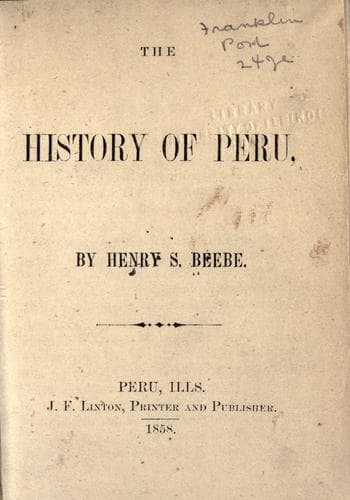
For some years, attention has been attracted to the Great Central Coal
Field of Illinois, the north eastern rim of which underlies the cities
of Peru and La Salle. From the earliest settlement of the country the
outcrops have been resorted to for fuel. More and more extensive
explorations and excavations have, from time to time, been made, excited
by the foresight, sagacity and scientific deductions of the pioneer of
that interest, Dixwell Lathrop, Esq. In 1855, a thorough examination was
made by J. G. Norwood, State Geologist, which demonstrated the existence
of three veins or strata, underlying an area of about 500 square miles.
These veins vary in thickness, from three and a half to seven feet, the
central being the thickest, but the value of the coal increasing with
the descent. The existence of another strata, still lower and still
better, is presumed, as the alluvial formation, or coal measures, has
not yet been passed by boring. A comparison of the analysis of these
coals with those of the best Pennsylvania and Ohio bituminous,
demonstrated that an open market could be successfully entered in
competition. Immediately afterwards, operations in mining were commenced
on a more extensive scale and more scientific principles.
Several shafts were sunk and powerful and improved machinery employed.
These shafts were sunk in and near La Salle, with one exception, which
was in the westerly part of Peru, immediately on the river bank, and on
the track of the Chicago and Rock Island Rail Road. The structures,
excavations, machinery and outfits of the company operating this shaft
are of the most perfect and approved kind. Their facilities for raising
are equal to three hundred tons per day. They are working the lower, or
best vein--four and a-half feet thick--exclusively, which they have
reached at probably its greatest depression, three hundred and forty-six
feet below the surface. Analysis and tests, made at many gas works and
manufactories, are conclusive in establishing the fact, that NO COAL HAS
YET BEEN RAISED, WEST OF OHIO AND NORTH OF THE OHIO RIVER, WHICH IS
EQUAL TO THE COAL FROM THIS SHAFT, FOR THE AMOUNT OF STEAM IT WILL
GENERATE, AND FOR ITS FREEDOM FROM SULPHUR AND TENDENCY TO CLINKER. What
is true of this shaft is true, in a degree, of the coal from the same
vein from the shafts at La Salle, the difference being due no doubt to
its greater depression.
Public-domain text, read in full here on John Shaqi.
Reviews
Reviews
No reviews yet
Be the first to share your thoughts on this work.
Join the Discussion
Join the discussion
Sign in to leave a comment or review.
Sign InorCreate an account