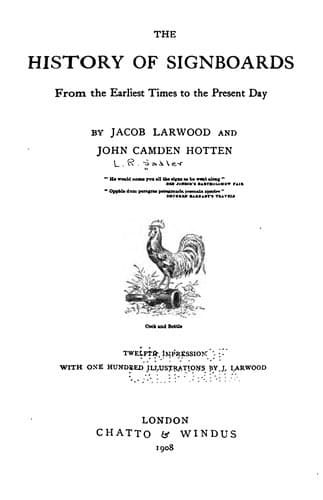
The History of Signboards, from the Earliest times to the Present DayHotten, John Camden
History
The History of Signboards, from the Earliest times to the Present Day
Hotten, John Camden
Inn signs -- England -- History; Signs and signboards -- History
[94] The “Dropping Well,” one of the most noted petrifying springs in
England, and so named on account of its percolating through the rock
that hangs over it.
[95] This information we gather from a chapbook entitled “The Strange
and Wonderful History and Prophecies of Mother Shipton, by Ferraby,
printer on the Market Place, Hull.” It is evidently a reprint of a
chapbook of the time of Charles II., as appears from many allusions.
[96] Once there was a man who led a holy life, and was a prophet, who
could see what would come to pass; his name was Merlin, and he was the
offspring of an evil and fiendish spirit. But though born from such a
father, he shone forth in virtue, and after his death, became a
companion of the saints.
[97] Henry Peacham’s Compleat Gentleman.
[98] John Collet’s Historical Anecdotes, Add. MSS. 8890, p. 113.
[99] In the Banks Collection.
[100] This broadside is reprinted in Notes and Queries for January 15,
1859. Sussex had its snake as late as 1614. There is a pamphlet In the
Harl. Collection, entitled, “True and Wonderful--a discourse relating a
strange and monstrous serpent, (or dragon,) lately discovered, and yet
living, to the great annoyance and divers slaughter both of men and
cattell, by his strong and violent Poyson, in Sussex, two miles from
Horsam, in a woode called St Leonard’s Forrest, and thirtie miles from
London, this present month of August 1614.” That this Sussex snake
caused a great sensation, appears from the fact that seventeen years
after, it is alluded to in “Whimsies: or, A New Cast of Characters,”
1631: “Nor comes his [the ballad-monger’s] invention far short of his
imagination. For want of truer relations for a neede, he can find you
out a _Sussex dragon_, some sea or inland monster, drawn out by some
Shoe Lane man, [_i.e._, a sign-painter; they all lived in Harp Alley,
Shoe Lane,] in Gorgon-like features, to enforce more horror in the
beholder.”
[101] The title of Cooper’s novel seems to have taken hold of the
popular fancy to an astonishing degree: not only are there several
public-houses who have adopted it as their sign, but also race-horses,
ships, and locomotive engines have been named after it. There is even a
baked potato-can in the streets of London, decorated with that name; it
is built in the shape of a locomotive-engine, japanned red, and wheeled
about the streets by an old woman. The name on a brass plate is screwed
to the can, similar to the names of locomotive-engines.
[102] Introduction to Tarlton’s Jests, by J. O. Halliwell.
[103] Harl. MSS. 3885.
[104] Gray’s Letter to Chute. Mitford, ii. 138.
[105] Banks’s Collection.
[106] This is engraved in Caulfield’s Portraits of Remarkable and
Eccentric Characters, as well as the wooden figure in the Tower.
[107] MSS. Reg., 2 A. xvi.
[108] Fairholt, Remarkable and Eccentric Characters, p. 56.
[109] Fuller’s Worthies, _voce_ Monmouthshire.
Public-domain text, read in full here on John Shaqi.
Reviews
Reviews
No reviews yet
Be the first to share your thoughts on this work.
Elsewhere in the archive
Join the Discussion
Join the discussion
Sign in to leave a comment or review.
Sign InorCreate an account