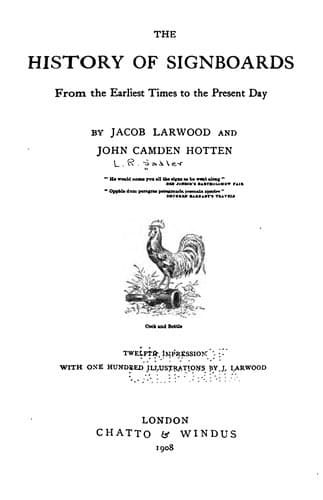
The History of Signboards, from the Earliest times to the Present DayHotten, John Camden
History
The History of Signboards, from the Earliest times to the Present Day
Hotten, John Camden
Inn signs -- England -- History; Signs and signboards -- History
[79] Addison’s Lion’s Head, the box for the deposition of the
correspondence of the _Guardian_, was originally placed at Button’s,
over against Tom’s in Great Russell Street. “After having become a
receptacle of papers and a spy for the _Guardian_, it was moved to the
Shakespeare’s Head Tavern, under the Piazza in Covent Garden, kept by a
person named Tomkins, and in 1751 was for a short time placed in the
Bedford Coffeehouse, immediately adjoining the Shakespeare Tavern, and
there employed as a medium of literary communication by Dr John Hill,
author of the ‘Inspector.’ In 1769, Tomkins was succeeded by his waiter,
named Campbell, as proprietor of the tavern and Lion’s Head, and by him
the latter was retained till 1804, when it was purchased by the late
Charles Richardson, after whose death in 1827 it devolved to his son,
and has since become the property of his Grace the Duke of
Bedford.”--Till, in his Preface to Descriptive Catalogue of English
Medals.
[80] Our slang friends the burlesque writers and parodists, would
probably say something about _mopping_.--ED.
[81] An “Apollo in his glory” is a charge in the apothecaries’ arms.
[82] Aubrey, Remains of Gentilisme and Judaism. Lansdowne MSS. 231, p.
106.
[83] At the Vulcan. He lights his pipe at the fire;--whosoever wants to
buy good tobacco let him come here;--you will get a pipe filled into the
bargain, and a glass of strong beer in fair time.
[84] Vulcan, that lame blacksmith, when he got tired over his work, sat
down a while to rest his limbs. The gods saw it; he took his cutty pipe
and his tobacco box out of his pocket and smoked a pipe of tobacco.
[85] _Gent. Mag._, March 1842.
[86] The History of Tom Jones, book xvi. ch. ii.
[87] _Lond. Gaz._, June 18-22, 1674.
[88] This was not true, for Pepys went (24th Oct. 1667) to hear the same
instrument played by a Mr Prin, a Frenchman, “which he do beyond belief,
and the truth is, it do so far outdo a trumpet as nothing more, and he
do play anything very true. The instrument is open at the end I
discovered, but he would not let me look into it.” Philips, in his “New
World of Words,” 1696, describes it as “an instrument with a bellows,
resembling a lute, having a long neck with a string, which being struck
with a hairbow sounds like a trumpet.”
[89] Aubrey, Miscellanies upon various subjects.
[90] See in Bib. Top. Brit., vol. iv., a Critical Memoir on the Story of
Guy of Warwick, by the Rev. Samuel Pegge, who supposes that Guy lived in
Saxon times, and was the son of Simon, Baron of Wallingford. He married
Felicia, (Phillis,) the daughter and heiress of Rohand, Earl of Warwick,
who flourished in the reign of Edward the Elder, and so became Earl of
Warwick.
[91] In Ritson’s Ancient Songs and Ballads.
[92] The “pindar” was the man who took care of stray cattle, which he
kept in the pinfold, or pound, until it was claimed and the expenses
paid.
[93] _Daily Courant_, Feb. 19, 1711.
Public-domain text, read in full here on John Shaqi.
Reviews
Reviews
No reviews yet
Be the first to share your thoughts on this work.
Elsewhere in the archive
Join the Discussion
Join the discussion
Sign in to leave a comment or review.
Sign InorCreate an account