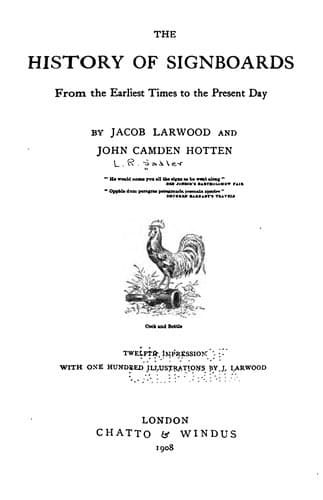
The History of Signboards, from the Earliest times to the Present DayHotten, John Camden
History
The History of Signboards, from the Earliest times to the Present Day
Hotten, John Camden
Inn signs -- England -- History; Signs and signboards -- History
[110] This is an old “dodge,” mentioned long ago by Decker in his “Seven
Deadly Sins, seven times pressed to Death,” &c.:--“Then you have another
brewing called Huff’s ale, at which, because no man must have _but a pot
at a sitting_, and so be gone, the restraint makes them more eager to
come in, so that by this policie one may huffe it four or five times a
day.”
[111] Journey through England, vol. i. p. 175.
[112] Metamorphosis of the Town; or, a View of the Present Fashions.
London: Printed for J. Wilford at the THREE FLOWER DE LUCES, behind the
Chapter House in St Paul’s Churchyard, 1730.
[113] Oddly enough, both Cave and Ponto are terms of some games at
cards.
[114] There is a copy in the British Museum.
[115] This _motto_ was: “Misura della Colonna di Christo n^{ro},”
_i.e._, Measure of the column of our Saviour.
[116] A brother Boniface, Adams, “at the ROYAL SWAN in Kingsland Road,
leading from Shoreditch Church,” (1756) had also a _knackatory_, which,
from his catalogue, looks very like a parody on the Don’s. He exhibited,
for instance, “Adam’s eldest daughter’s hat;” “the heart of famous Bess
Adams, that was hanged with Lawyer Carr, January 18, 1736-37;” “the
Vicar of Bray’s clogs;” “an engine to shell green peas with;” “teeth
that grew in a fish’s belly;” “Black Jack’s ribs;” “the very comb that
Adam combed his son Isaac’s and Jacob’s head with;” “rope that cured
Captain Lowry of the headach, earach, toothach, and bellyach;” “Adam’s
key to the fore and back door of the garden of Eden,” &c., &c., and 500
other curiosities.
[117] Her portrait, with a poem upon her, too long to quote, occurs in
“Portraits and Lives of Remarkable and Eccentric Characters,”
Westminster, 1819.
[118] Harl. MSS. 5900.
[119] Bagford Bills. Harl. MSS. 5962.
[120] London, Past and Present, p. 48.
CHAPTER III.
HERALDIC AND EMBLEMATIC SIGNS.
Royalty stands prominently at the head of the heraldic signs in its
triple hieroglyphic of the Crown, (no coronets ever occur,) the King’s
or Queen’s Arms, and the various royal badges.
The CROWN seems to be one of the oldest of English signs. We read of it
as early as 1467, when a certain Walter Walters, who kept the Crown in
Cheapside, made an innocent Cockney pun, saying he would make his son
heir to the Crown, which so displeased his gracious majesty, King Edward
IV., that he ordered the man to be put to death for high treason.
Public-domain text, read in full here on John Shaqi.
Reviews
Reviews
No reviews yet
Be the first to share your thoughts on this work.
Elsewhere in the archive
Join the Discussion
Join the discussion
Sign in to leave a comment or review.
Sign InorCreate an account