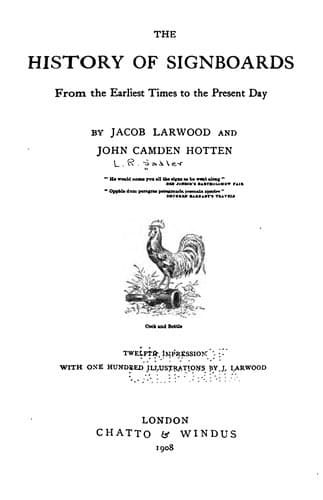
The History of Signboards, from the Earliest times to the Present DayHotten, John Camden
History
The History of Signboards, from the Earliest times to the Present Day
Hotten, John Camden
Inn signs -- England -- History; Signs and signboards -- History
The Crown Inn at Oxford was kept by Davenant, (Sir William Davenant’s
father.) Shakespeare, on his frequent journeys between London and his
native place, generally put up at this inn, and the malicious world said
that young Davenant (the future Sir William) was somewhat nearer related
to him than as a godson only. One day, when Shakespeare was just
arrived, and the boy sent for from school to see him, a master of one of
the colleges, pretty well acquainted with the affairs of the family,
asked the boy why he was going home in so much haste, who answered, that
he was going to see his godfather Shakespeare. “Fie, child,” said the
old gentleman, “why are you so superfluous? Have you not learnt yet that
you should not use the name of God in vain?”
On the site occupied by the present Bank of England there used to stand
four taverns; one of them bore the sign of the Crown, and was certainly
in a good line of business, for, according to Sir John Hawkins,[121] it
was not unusual in those toping days to draw a butt (120 gallons) of
mountain in half-pints in the course of a single morning.
About the same period there was another Crown Tavern in Duck Lane, W.
Smithfield. One of the rooms in that house was decorated by Isaac Fuller
(ob. 1672) with pictures of the Muses, Pallas, Mars, Ajax, Ulysses, &c.
Ned Ward praises them highly in his “London Spy.” “The dead figures
appeared with such lively majesty that they begot reverence in the
spectators towards the awful shadows!” Such painted rooms in taverns
were not uncommon at that period.
The origin of the sign of the THREE CROWNS is thus accounted for by
Bagford:[122]--“The mercers trading with Collen (Cologne) set vp ther
singes ouer ther dores of ther Houses the three kinges of Collen, with
the Armes of that Citye, which was the Three Crouens of the former
kinges, in memory of them, and by those singes the people knew in what
wares they deld in.” Afterwards, like all other signs, it was used
promiscuously, and thus it gave a name to a good old-fashioned inn in
Lichfield, the property of Dr Johnson, and the very next house to that
in which the doctor was born.
Public-domain text, read in full here on John Shaqi.
Reviews
Reviews
No reviews yet
Be the first to share your thoughts on this work.
Elsewhere in the archive
Join the Discussion
Join the discussion
Sign in to leave a comment or review.
Sign InorCreate an account