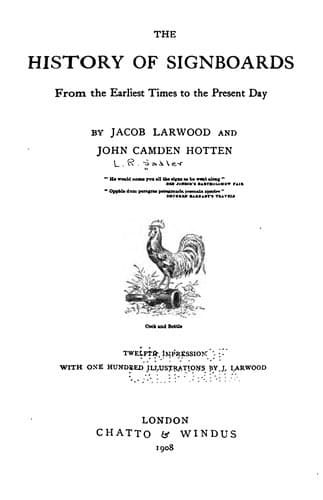
The History of Signboards, from the Earliest times to the Present DayHotten, John Camden
History
The History of Signboards, from the Earliest times to the Present Day
Hotten, John Camden
Inn signs -- England -- History; Signs and signboards -- History
Frequently the Royal Crown is combined with other objects, to amplify
the meaning, or to express some particular prerogative; such are the
CROWN AND CUSHION, being the Crown as it is carried before the king in
coronation, and other ceremonies. We even meet with the TWO CROWNS AND
CUSHIONS; that is, the Crown for the King and for the Queen, which was
the sign of a Mr Arne, an upholsterer in Covent Garden, the hero of
several _Tatlers_ and _Spectators_, and father of the celebrated
musician and composer, Dr Arne. This political upholsterer also figures
in a farce by Murphy, entitled “The Upholsterer; or what news?” The four
Indian princes referred to in _Tatler_, No. 155, who came to England in
the reign of Queen Anne, to implore the help of the British Government
against the encroachments of the French in Canada, seem to have lodged
in this man’s house,--a circumstance frequently alluded to in the papers
of the _Tatler_ and other periodicals of the time.
The CROWN AND GLOVE refers to the well-known ceremony of the Royal
Champion at the Coronation. It occurs as a sign at Stannington,
Sheffield, Eastgate Row, South Chester, &c. The ROYAL CHAMPION himself
figures in George Street, Oxford. In the _Gazetteer_ for August 20,
1784, we find an anecdote recorded concerning the Royal Champion, which
is almost too good to be true:--“At the coronation of King William and
Queen Mary, the Champion of England dressed in armour of complete and
glittering steel; his horse richly caparisoned, and himself, and beaver
finely capped with plumes of feathers, entered Westminster Hall while
the King and Queen were at dinner. And, at giving the usual challenge
to any one that disputed their majesties’ right to the crown of England,
(when he has the honour to drink the Sovereign’s health out of a golden
cup, always his fee,) after he had flung down his gauntlet on the
pavement, an old woman, who entered the hall on crutches, (which she
left behind her,) took it up, and made off with great celerity, leaving
her own glove, with a challenge in it to meet her the next day at an
appointed hour in Hyde Park. This occasioned some mirth at the lower end
of the hall: and it was remarkable that every one was too well engaged
to pursue her. A person in the same dress appeared the next day at the
place appointed, though it was generally supposed to be a good swordsman
in that disguise. However, the Champion of England politely declined any
contest of that nature with the fair sex, and never made his
appearance.”
Public-domain text, read in full here on John Shaqi.
Reviews
Reviews
No reviews yet
Be the first to share your thoughts on this work.
Elsewhere in the archive
Join the Discussion
Join the discussion
Sign in to leave a comment or review.
Sign InorCreate an account