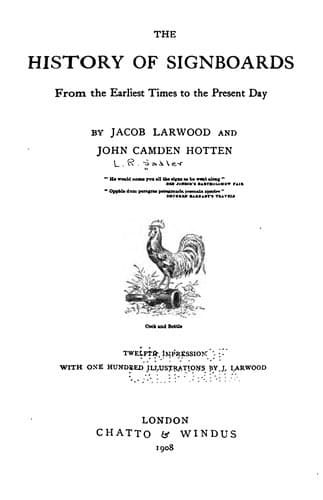
The History of Signboards, from the Earliest times to the Present DayHotten, John Camden
History
The History of Signboards, from the Earliest times to the Present Day
Hotten, John Camden
Inn signs -- England -- History; Signs and signboards -- History
The CROWN AND SCEPTRE, another of the royal insignia, is named by
Misson[123] in the following incident:--“Butler, the keeper of the Crown
and Sceptre tavern, in St Martin’s Lane, told me that there was a tun of
red port drunk at his wife’s burial, besides mulled white wine.
_Note._--No men ever goe to women’s burials, nor the women to the men’s;
so that there were none but women at the drinking of Butler’s wine. Such
women in England will hold it out with the men, when they have a bottle
before them, as well as upon th’ other occasion, and tattle infinitely
better than they.”
The CROWN AND MITRE, indicative of royalty and the church, is the sign
of a High Church publican at Taunton; and the BIBLE AND CROWN has for
more than a century and a half been the sign of Rivingtons the
publishers. (See under Religious Signs.) The King and Parliament are
represented by the well-known CROWN AND WOOLPACK, which at Gedney
Holbeach, in Lincolnshire, has been corrupted into the CROWN AND
WOODPECKER. The CROWN AND TOWER, at Taunton, may refer to the regalia
kept in the Tower, or to the king being “a tower of strength.” A similar
symbol seems to be intended in the CROWN AND COLUMN, Ker Street,
Devonport, perhaps implying the strength of royalty when supported by a
powerful and united nation.
The CROWN AND ANCHOR, the well-known badge of the Navy, is a great
favourite. One of the most famous taverns with this sign was in the
Strand, where Dr Johnson often used to “make a night of it.” “Soon
afterwards,” says Boswell, “in 1768, he supped at the Crown and Anchor
in the Strand, with a company whom I collected to meet him. There were
Dr Percy, now bishop of Dromore; Dr Douglas, now bishop of Salisbury; Mr
Langton; Dr Robertson, the historian; Dr Hugh Blair, and Mr Thomas
Davis.” On this occasion the great doctor was unusually colloquial, and
according to his amiable custom “tossed and gored several persons.”
The famous “Crown and Anchor Association” against so-called _Republicans
and Levellers_--as the reformers were styled by the ministerial party in
1792--owed its name to this tavern. Its rise and progress is rather
curious: it was undertaken at the instance of Pitt and Dundas, by John
Reeves, a barrister. Reeves, at first, could get no one to join him,
but, to meet the wishes of his employers, used to go to the Crown and
Anchor, draw up some resolutions, pass them _nem. con._, and sign them
_John Reeves_, chairman: thus being in his own person, meeting,
chairman, and secretary. In this way they were inserted in all the
papers of the three kingdoms, the expense being no object to the persons
concerned. Meetings of the counties were advertised, but the first,
second, and third consisted of Reeves alone, and it was not till the
fourth meeting that he had any coadjutors. The political effervescence
created by this society, its imitations and branches, form part of the
history of the nation.
Public-domain text, read in full here on John Shaqi.
Reviews
Reviews
No reviews yet
Be the first to share your thoughts on this work.
Elsewhere in the archive
Join the Discussion
Join the discussion
Sign in to leave a comment or review.
Sign InorCreate an account