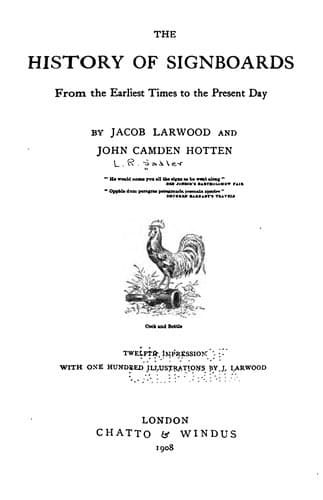
The History of Signboards, from the Earliest times to the Present DayHotten, John Camden
History
The History of Signboards, from the Earliest times to the Present Day
Hotten, John Camden
Inn signs -- England -- History; Signs and signboards -- History
In the year 1800 the Farming Society proposed to have an experimental
dinner in order to ascertain the relative qualities of the various
breeds of cattle in the kingdom; the dinner was planned and patronised
by Sir John Sinclair, and the execution intrusted to Mr Simpkins,
landlord of the Crown and Anchor, who sent a tender of the most
Brobdignagian dinner probably ever heard of. Twelve kinds of oxen and
sheep of the most famous breed, eight kinds of pork, and various
specimens of poultry, were to bleed as victims in this holocaust to the
devil of gluttony; the fish was only to be from fresh waters, such as
were “entitled to the attention of British farmers;” there were various
kinds of vegetables, nine sorts of bread, besides veal, lamb, hams,
poultry, tarts and puddings, all of which were to be washed down by a
variety of strong and mild ales, stout, cider, Perry, and “British”
spirits. Tickets one guinea each.[124]
The ANCHOR AND CROWN was also the sign of the great booth at Greenwich
fair; it was 323 feet long, and 60 feet wide, was used for dancing, and
could easily accommodate 2000 persons at a time. The other booths also
had signs; amongst them were the ROYAL STANDARD, the LADS OF THE
VILLAGE, the BLACK BOY AND CAT, the MOONRAKERS, and others.
The CROWN AND DOVE, Bridewell Street, Bristol, may refer to the order of
the Holy Ghost, or may have been suggested by the THREE PIGEONS AND
SCEPTRE.
Objects of various trades, with a crown above them, were very common:
the CROWN AND FAN was an ordinary fan-maker’s sign.[125] The CROWN AND
RASP, belonging to snuff-makers, occurs as the sign of Fribourg and
Treyer, tobacconists, at the upper end of Pall Mall, near the Haymarket,
in 1781: it is still to be seen on the façade of the house. The oldest
form of taking snuff was to scrape it with a rasp from the dry root of
the tobacco plant; the powder was then placed on the back of the hand
and so snuffed up; hence the name of _râpé_ (rasped) for a kind of
snuff, and the common tobacconist’s sign of LA CAROTTE D’OR, (the golden
root,) in France. The rasps for this purpose were carried in the
waistcoat pocket, and soon became articles of luxury, being carved in
ivory and variously enriched. Some of them, in ivory and inlaid wood,
may be seen at the Hôtel Cluny in Paris, and an engraving of such an
object occurs in “Archæologia,” vol. xiii. One of the first snuff-boxes
was the so-called râpé, or _grivoise_ box, at the back of which was a
little space for a piece of the root, whilst a small iron rasp was
contained in the middle. When a pinch was wanted, the root was drawn a
few times over the iron rasp, and so the snuff was produced and could be
offered to a friend with much more grace than under the above-mentioned
process with the pocket grater.
The CROWN AND LAST originated with shoemakers, but the gentle craft
having the reputation of being thirsty souls, it was also adopted as an
alehouse sign: we find it as such in 1718:--
Public-domain text, read in full here on John Shaqi.
Reviews
Reviews
No reviews yet
Be the first to share your thoughts on this work.
Elsewhere in the archive
Join the Discussion
Join the discussion
Sign in to leave a comment or review.
Sign InorCreate an account