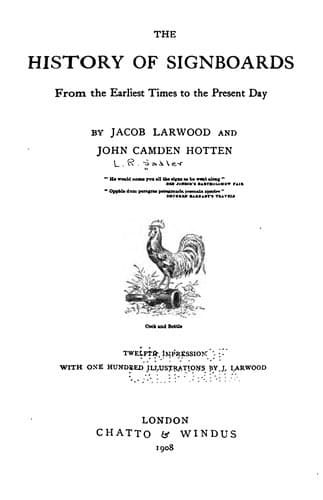
The History of Signboards, from the Earliest times to the Present DayHotten, John Camden
History
The History of Signboards, from the Earliest times to the Present Day
Hotten, John Camden
Inn signs -- England -- History; Signs and signboards -- History
“ON EASTER Monday, at the Crown and Last at Primlico (_sic_) in
Chelsea road, a silver watch, value 30 sh., is to be bowled for; three
bowls for six pence, to begin at Eight of the clock in the morning and
continues till Eight in the evening. N.B.--They that win the watch may
have it or 30s.”[126]
The CROWN AND HALBERT was, in 1790, the sign of a cutler in St Martin’s
Churchyard;[127] the CROWN AND CAN occurs in St John Street; and the
CROWN AND TRUMPET at Broadway, Worcester: this last may either allude to
the trumpet of the royal herald, or simply signify a crowned trumpet.
Of the KING’S ARMS, and the QUEEN’S ARMS, there are innumerable
instances; they are to be found in almost every town or village. The
story is told that a simple clodhopper once walked ever so many miles to
see King George IV. on one of his journeys, and came home mightily
disgusted, for the king had arms like any other man, while he had always
understood that his majesty’s right arm was a lion and his left arm a
unicorn.
Grinling Gibbons, the celebrated carver and sculptor, lived at the sign
of the King’s Arms in Bow Street, from 1678 until 1721, when he died.
This house is alluded to in the _Postman_, January 24, 1701-2:--
“On Thursday, the house of Mr Gibbons, the carver in Bow Street, fell
down, but by special providence none of the family were killed; but,
’tis said, a young girl which was playing in the court being missed,
is supposed to be buried in the rubbish.”
At the Haymarket, corner of Pall Mall, stood the QUEEN’S ARMS tavern, in
the reign of Queen Anne. At the accession of George I. it was called the
King’s Arms, and there, in 1734, the Whig party used to meet to plan
opposition to Sir Robert Walpole. This club went by the name of the
Rump-steak Club.
Faulkner[128] says that at the King’s Arms, in the High Street, Fulham,
the Great Fire of London was annually commemorated on the 1st of
September, and had been continued without interruption until his time.
It was said to have taken its rise from a number of Londoners who had
been burnt out, and who, having no employment, strolled out to Fulham,
on their way collecting a quantity of hazel nuts, from the hedges, with
which they resorted to this house. A capital picture of the great
conflagration used to be exhibited on that day.
Public-domain text, read in full here on John Shaqi.
Reviews
Reviews
No reviews yet
Be the first to share your thoughts on this work.
Elsewhere in the archive
Join the Discussion
Join the discussion
Sign in to leave a comment or review.
Sign InorCreate an account