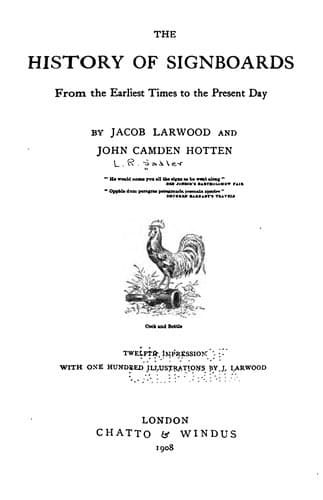
The History of Signboards, from the Earliest times to the Present DayHotten, John Camden
History
The History of Signboards, from the Earliest times to the Present Day
Hotten, John Camden
Inn signs -- England -- History; Signs and signboards -- History
The HAWTHORN, or HAWTHORNBUSH, which we meet in so many places, may be
Henry VII.’s badge, but various other causes may have contributed to the
popularity of that sign, such as the custom of gathering bunches of
hawthorn on the first of May. Magic powers, too, are attributed to this
plant. “And now,” says Reginald Scott, “to be delivered from witches
themselves they hange in their entrees an hearb called pentaphyllon,
cinquefole, also an oliue branch, also franckincense, myrrh, valerian
veruen, palme, anterihmon, &c.; also _Haythorne, otherwise whitethorne,
gathered on Maiedaie_,” &c.[147]
The GUN, or CANNON, was the cognizance of King Edward VI., Queen Mary,
and Queen Elizabeth. In the beginning of the eighteenth century it was
of such frequent occurrence that the _Craftsman_, No. 638,
observed--“Nothing is more common in England than the sign of a cannon.”
Sarah Milwood, the “wanton” who led George Barnwell astray, lived,
according to the ballad, in Shoreditch, “next door unto the Gun.” At the
present day it is still a great favourite. In the neighbourhood of
arsenals its adoption is easily explained.
About eighty years ago there was a famous Cannon Coffee-house at the
corner of Trafalgar Square, at the end of Whitcombe Street or Hedgelane;
its site is now occupied by the Union Club. From this coffeehouse
Hackman saw Miss Ray drive past on her way to Covent Garden Theatre,
when he followed and shot her as she was entering her coach after the
performance. The Gun was also a sign with many booksellers, as in the
case of Edward White at the Little North Door of St Paul’s Church,
1579; Thomas Ewster in Ivy Lane, 1649; Henry Brome, at the West End of
St Paul’s Churchyard, 1678, and various others.
The SWAN was a favourite badge of several of our kings, as Henry IV.,
Edward III. At a tournament in Smithfield the last king wore the
following rather profane motto:--
“Hay, hay, the wyth Swan,
By God’s soule I am thy man.”
Thomas Woodstock, Duke of Gloucester, used the same cognizance; whence
Gower styles him “cignus de corde benignus;” whilst Cecily Nevil,
Duchess of York, mother of Edward IV. and Richard III., likewise had a
swan as supporter of her arms.
The sign of the SWAN AND MAIDENHEAD, at Stratford-on-Avon, may have
originated in one of the royal badges; for we find that in 1375 the
Black Prince bequeathed to his son Richard his hangings for a hall,
embroidered with mermen, and a border of red and black empaled,
embroidered with _swans having ladies’ heads_.[148] The SWAN AND FALCON
(two badges of Edward III.) was a sign in Hereford, in 1775, as appears
from the following advertisement:--
“HEREFORD MACHINE.
“IN a Day and a Half twice a week, continues flying from the Swan and
Falcon, in Hereford, Monday and Thursday mornings; and from the
Bolt-in-Tun, in Fleet Street, London, Monday and Thursday evenings.
Fare 19s.; outsides half.”--_Hereford Journal, January 12, 1775._
Public-domain text, read in full here on John Shaqi.
Reviews
Reviews
No reviews yet
Be the first to share your thoughts on this work.
Elsewhere in the archive
Join the Discussion
Join the discussion
Sign in to leave a comment or review.
Sign InorCreate an account