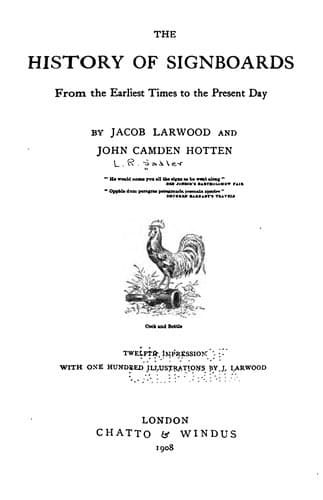
The History of Signboards, from the Earliest times to the Present DayHotten, John Camden
History
The History of Signboards, from the Earliest times to the Present Day
Hotten, John Camden
Inn signs -- England -- History; Signs and signboards -- History
The SWAN AND WHITE HART may have been originally the Swan and Antelope,
supporters of the arms of Henry IV., but as it at present stands two
distinct royal badges are represented. This sign occurs on a
trades-token of St Giles in the Fields, in the second half of the
seventeenth century.
The RISING SUN was a badge of Edward III., and forms part of the arms of
Ireland; but the Sun Shining was a cognizance of several kings. Various
other causes may have led to the adoption of that luminary as a sign.
(See Miscellaneous Signs.)
Lions have been at all times, and still continue, greater signboard
favourites than any other heraldic animals. The lion rampant most
frequently occurs, although in late years naturalism has crept in, and
the _felis leo_ is often represented standing or crouching, quite
regardless of his heraldic origin. The lion of the signboard being
seldom seen _passant_, it is more than probable that it was not derived
from the national coat of arms, but rather from some badge, either that
of Edward III. or from the WHITE LION of Edward IV. Though silver in
general was not used on English signboards yet, the White Lion was
anything but uncommon. Several examples occur amongst early booksellers.
Thus in 1604 the “Shepherd’s Calendar” was “printed at London by G.
Elde, for Thomas Adams, dwelling in Paule’s Churchyarde, at the signe of
the White Lion.” In 1652 we meet with another bookseller, John Fey, near
the New Exchange; and about the same period John Andrews, a ballad
printer, near Pye Corner, who both had the sign of the White Lion. For
inns, also, it was not an uncommon decoration. Thus the White Lion in St
John’s Street, Clerkenwell, was originally an inn frequented by
cattle-drovers and other wayfarers connected with Smithfield market.
Formerly it was a very extensive building, two of the adjoining houses
and part of White Lion Street, all being built on its site. The house
now occupied by an oilshop was in those days the gateway to the
inn-yard, and over it was the sign, in stone relief, a lion rampant,
painted white, inserted in the front wall. It still remains in its
original position, with the date 1714, when it was probably renewed.
Pepys’s cousin, Anthony Joyce, drowned himself in a pond behind this
inn. He was a tavern-keeper himself, and kept the THREE STAGS at
Holborn, (a house of which tokens are extant.) Heavy losses by the fire
of 1666 preyed upon his mind. He imagined that he had not served God as
he ought to have done, and in a moment of despair committed the rash
act. We have another, and not uninteresting instance, of this sign. Sir
Thomas Lawrence’s father kept the White Lion Hotel at Bristol. He
afterwards removed to the Bear, at Devizes, where he failed in business.
It seemed that it was this last speculation in hotel-keeping which
ruined him, with reference to which local wits used to say, “It was not
the Lion but the Bear that eat him up.”--_Bristol Times_, June 4, 1859.
Public-domain text, read in full here on John Shaqi.
Reviews
Reviews
No reviews yet
Be the first to share your thoughts on this work.
Elsewhere in the archive
Join the Discussion
Join the discussion
Sign in to leave a comment or review.
Sign InorCreate an account