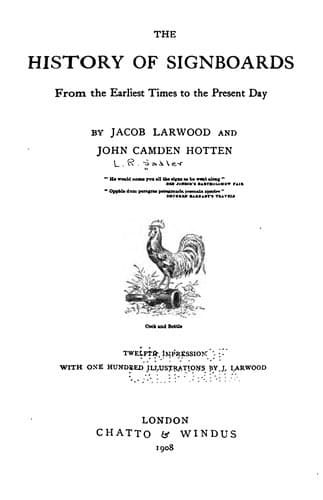
The History of Signboards, from the Earliest times to the Present DayHotten, John Camden
History
The History of Signboards, from the Earliest times to the Present Day
Hotten, John Camden
Inn signs -- England -- History; Signs and signboards -- History
Since pictorial or carved signs have fallen into disuse, and only names
given, the SILVER LION is not uncommon, though in all probability simply
adopted as a change from the very frequent Golden Lion. Thus there is
one in the High Street, Poplar; in the London Road, and Midland Road,
Derby; in the Lilly Road, Luton, Herts, &c. The Red Lion is by far the
most common; doubtless it originated with the badge of John of Gaunt,
Duke of Lancaster, married to Constance, daughter of Don Pedro the
Cruel, king of Leon and Castille. The duke bore the lion rampant gules
of Leon as his cognizance, to represent his claim to the throne of
Castille, when that was occupied by Henry de Transtamare. In after years
it may often have been used to represent the lion of Scotland.
The Red Lion Inn at Sittingbourne is a very ancient establishment. A new
landlord, who entered _circa_ 1820, issued the following
advertisement:--
“WM. WHITAKER having taken the above house, most respectfully solicits
the custom and support of the nobility and gentry, &c., &c.
“The antiquity of the inn, and the respectable character which it has
in history are recorded as under:--
“Sittingbourne, in Kent, is a considerable thoroughfare on the Dover
Road, where there are several good inns, particularly the Red Lion,
which is remarkable for an entertainment, made by Mr John Norwood, for
King Henry the Fifth, _as he returned from the battle of Agincourt, in
France, in the year 1415, the whole amounting to no more than Nine
Shillings and Ninepence_. Wine being at that time only a penny a pint,
and all other things being proportionably cheap.
_P.S._--The same character in a like proportionate degree Wm. Whitaker
hopes to obtain by his moderate charges at the present time.”
Red Lion Square, Holborn, was called after an inn known as the Red Lion.
“Andrew Marvell lies interred under y^{e} pews in the south side of St
Giles church in y^{e} Fields, under the window wherein is painted on
glasse, a red lyon, (it was given by the Inneholder of the Red lyon
Inne, Holborn.)”[149]
Another celebrated tavern was the Old Red Lion, St John’s Road,
Islington,--which has been honoured by the presence of several great
literary characters. Thomson, of the “Seasons,” was a frequent visitor;
Paine, the author of the “Rights of Man,” lived, here; and Dr Johnson,
with his friends, are said often to have sat in the parlour. Hogarth
introduced its gable end in his picture of Evening.
The BLACK LION is somewhat uncommon; it may have been derived from the
coat of arms of Queen Philippa of Hainault, wife of Edward III.[150] We
find an example of it in the following advertisement:--[151]
“AT THE UNION SOCIETY at the Black Lion against Short’s Garden in
Drury Lane, a Linen Draper’s, on Thursday the 21st past, _was_ opened
three offices of Insurance on the birth of Children, by way of
dividend. At the same place there is two offices for marriages,” &c.
Public-domain text, read in full here on John Shaqi.
Reviews
Reviews
No reviews yet
Be the first to share your thoughts on this work.
Elsewhere in the archive
Join the Discussion
Join the discussion
Sign in to leave a comment or review.
Sign InorCreate an account