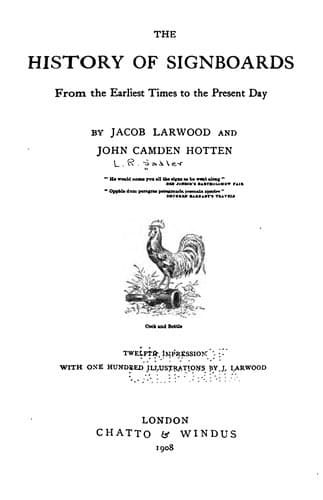
The History of Signboards, from the Earliest times to the Present DayHotten, John Camden
History
The History of Signboards, from the Earliest times to the Present Day
Hotten, John Camden
Inn signs -- England -- History; Signs and signboards -- History
In this advertisement we touch upon the joint-stock mania then raging.
Newspapers of the time teemed with advertisements of insurance companies
of all sorts: the above paper, with less than a dozen advertisements,
offers four schemes, by which on payment of 10s. per week £1000 were
eventually to be received!
Among the badges of the Tudors, Henry VII. and Henry VIII. left us the
still common sign of the PORTCULLIS.
“A portcullis, or porte-coulisse, is French for that wooden instrument
or machine, plated over with iron, made in the form of a harrow or
lozenge, hung up with pullies in the entries of gates or castles, to
be let down upon any occasion.”--_Anstis Garter._
It is the principal charge in the arms of the city of Westminster, and
is to be seen everywhere within and without the beautiful chapel of
Henry VII., whose favourite device it was as importing his descent from
the house of Lancaster. It was also one of the badges of Henry VIII.,
with the motto, _Securitas Altera_, and occurs on some of his coins.
To this same family we also owe the ROSE AND CROWN, which sign, at the
present day, may be observed on not less than forty-eight public-houses
in London alone, exclusive of beer-houses. One of the oldest is in the
High Street, Knightsbridge, which has been licensed above three hundred
years, though not under that name, for anciently it was called the
OLIVER CROMWELL. The Protector’s bodyguard is said to have been
quartered here, and an inscription to that effect was formerly painted
in front of the house, accompanied by an emblazoned coat of arms of
Cromwell, on an ornamental piece of plaster work, which last is all that
now remains of it. It is the oldest house in Brompton, was formerly its
largest inn, and not improbably the house at which Sir Thomas Wyatt put
up, while his Kentish followers rested on the adjacent green. Corbould
painted this inn under the title of “The Old Hostelrie at
Knightsbridge,” exhibited in 1849, but he transferred its date to 1497,
altering the house according to his own fancy.
During the persecutions, in the reign of Queen Elizabeth, of booksellers
suspected as publishers of the mysterious Martin Marprelate tracts, we
find one Bogue, at the loyal sign of the Rose and Crown, in St Paul’s
Churchyard, who fell into the category of the suspected, and who was so
severely persecuted that he was almost ruined by it.
Public-domain text, read in full here on John Shaqi.
Reviews
Reviews
No reviews yet
Be the first to share your thoughts on this work.
Elsewhere in the archive
Join the Discussion
Join the discussion
Sign in to leave a comment or review.
Sign InorCreate an account