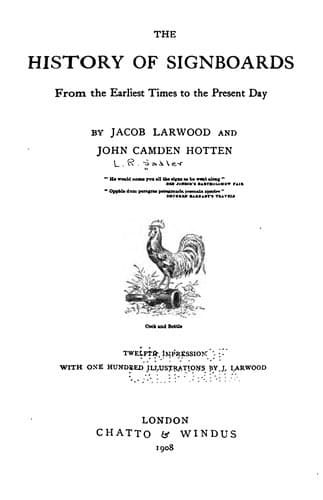
The History of Signboards, from the Earliest times to the Present DayHotten, John Camden
History
The History of Signboards, from the Earliest times to the Present Day
Hotten, John Camden
Inn signs -- England -- History; Signs and signboards -- History
County arms also are sometimes represented on the signboards; as the
FIFTEEN BALLS, (which refer to the Cornish arms, fifteen roundles
arranged in triangular form) at Union Street, Bodmin, Cornwall; ONE AND
ALL, the motto of the county of Cornwall, occurs at Cheapside, St
Heliers, Jersey; and in Market Jew Street, Penzance. This motto has,
besides the advantage of being a hearty appeal to all the thirsty sons
of Bacchus, and will call to the mind of a thoughtful toper, the
relative position of _one_ and _many_, or _all_, as explained by the
_al-fresco_ artists, who decorate the pavement in Piccadilly--“Many can
help one, one cannot help many.” The STAFFORDSHIRE KNOT is common in the
pottery districts; besides these almost every county is represented by
its own arms, such as the NORTHUMBERLAND ARMS, &c., but about these
nothing need be said.
The THREE BALLS of the pawnbrokers are taken from the lower part of the
coat of arms of the Dukes of Medici, from whose states, and from
Lombardy, nearly all the early bankers came. These capitalists also
advanced money on valuable goods, and hence gradually became
pawnbrokers. The arms of the Medici family were five bezants azure,
whence the balls formerly were blue, and only within the last half
century have assumed a golden exterior, evidently to gild the pill for
those who have dealings with “my uncle;” as for the position in which
they are placed, the popular explanation is that there are two chances
to one that whatever is brought there will not be redeemed.
The LION AND CASTLE, of which there are a few instances, (Cherry Garden
Stairs, Rotherhithe, for example,) need not be derived from royal
marriage alliances with Spain, as it may simply have been borrowed from
the brand of the Spanish arms on the sherry casks, and have been put up
by the landlord to indicate the sale of genuine Spanish wines, such as
sack, canary, mountain.
The FLOWER DE LUCE was a frequent English sign in old times, either
taken from the quartering of the French arms with the English, or set up
as a compliment to private families who bear this charge in their arms
or as crest. The preface of “Edyth, the lying widow,” ends with these
words:--
“In the cyte of Exeter by West away
The time not passed hence many a day,
There dwelled a yoman discret and wise,
At the siggne of the Flower de lyse
Which had to name John Hawkyn.”
Public-domain text, read in full here on John Shaqi.
Reviews
Reviews
No reviews yet
Be the first to share your thoughts on this work.
Elsewhere in the archive
Join the Discussion
Join the discussion
Sign in to leave a comment or review.
Sign InorCreate an account