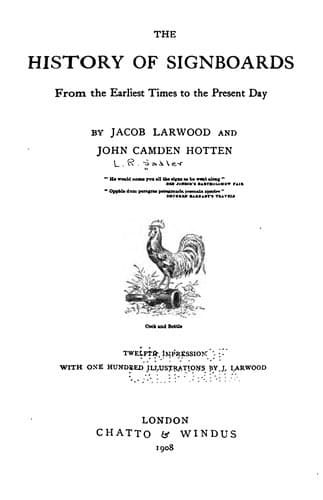
The History of Signboards, from the Earliest times to the Present DayHotten, John Camden
History
The History of Signboards, from the Earliest times to the Present Day
Hotten, John Camden
Inn signs -- England -- History; Signs and signboards -- History
Tokens are extant of an inn at Dover, in the seventeenth century, with
the sign of the FRENCH ARMS, a tavern name sufficiently common also in
London at that period to attract the travellers from across the Channel.
Thus James Johnson was a goldsmith, “that kept running cash,”--_i.e._, a
banker,--in Cheapside, in 1677, living at the sign of the THREE FLOWER
DE LUCES.[158] In the fifteenth century, Gascon merchants and other
strangers in London were allowed to keep hostels for their countrymen,
and, in order to get known, they most likely put up the arms of those
countries as their signs. No doubt the THREE FROGS, London Road,
Wokingham, is a travesty of _Johnny Crapaud’s Arms_.
[Illustration: PLATE VII.
HEDGEHOG.
(Bynneman’s sign, 1560.)
BLUE BOAR.
(Banks’s Collection, 1765.)
THE VALIANT LONDON APPRENTICE.
(From an old chapbook, 17th cent.)
THE SUN.
(Sign of Wynkyn de Worde, 1497.)
THREE PHEASANTS AND SCEPTRE.
(Banks’s Bills, 1795.)]
Boursault,[159] in his letter to Bizotin, has a burst of indignation at
a “_fournisseur_” of something or other to the royal family, who had
adopted as his sign the ENGLISH ARMS, with the arms of France in the
first quarter, and endeavours to call down the ire of the Parisian
police upon the head of the unfortunate shopkeeper who had committed
this act of treason:--
“Laissons l’Angleterre se repaître de chimères,” saith he, “et
s’imaginer que ses souverains sont Rois de France, mais que des
Français soyent assez ignorants, ou assez mauvais sujets, pour mettre
les armes de France écartelés dans celles d’Angleterre, c’est ce que
des sujets aussi zélez que Monsieur d’Argenson et les autres officiers
préposez pour la police ne doivent nullement souffrir.”[160]
He next, in a threatening manner, reminds the poor shopkeeper how,
according to “Candem [_sic_] Historien Angloys,” Queen Mary Stuart was
beheaded for having quartered the English arms with those of Scotland,
though she was the heir-presumptive of the English throne; and if such
was the fate of that queen, what then did the man deserve who quartered
the arms of his sovereign with those of a foreign king? Indeed he
deserved the same fate as the arms.
Another sign, apparently of French origin, is the DOLPHIN AND CROWN, the
armorial bearing of the French Dauphin, and the sign of R. Willington, a
bookseller in St Paul’s Churchyard _circa_ 1700. Some years after, this
house seems to have been occupied by James Young, a famous maker of
violins and other musical instruments, who lived at the west corner of
London House Yard, St Paul’s Churchyard. On this man the following
catch appeared in the _Pleasant Musicall Companion_, 1726:--
Public-domain text, read in full here on John Shaqi.
Reviews
Reviews
No reviews yet
Be the first to share your thoughts on this work.
Elsewhere in the archive
Join the Discussion
Join the discussion
Sign in to leave a comment or review.
Sign InorCreate an account