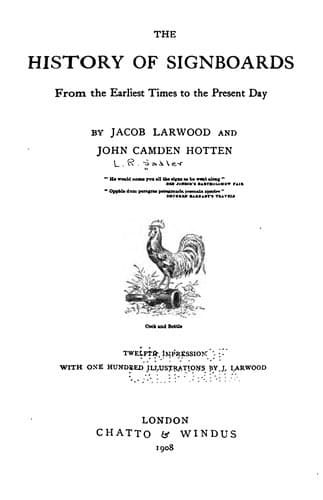
The History of Signboards, from the Earliest times to the Present DayHotten, John Camden
History
The History of Signboards, from the Earliest times to the Present Day
Hotten, John Camden
Inn signs -- England -- History; Signs and signboards -- History
“You scrapers that want a good fiddle well strung,
You must go to the man that is old while he’s Young;
But if this same fiddle you fain would play bold,
You must go to his son, who’s Young when he’s old.
There’s old Young and young Young, both men of renown:
Old sells and young plays the best fiddle in town.
Young and old live together, and may they live long--
Young to play an old fiddle, old to sell a new song.”
This Young family afterwards removed to the QUEEN’S HEAD Tavern in
Paternoster Row, where in a few years they grew rich by giving concerts,
when they removed to the CASTLE in the same street. The Castle concerts
continued a long time to be celebrated.
Many signs are exceedingly puzzling under the name by which they pass
with the public. Such was that of “Rowland Hall, dwelling in Guttur
Lane, at the sygne of the HALF EAGLE AND KEY.” This quaint sign is no
other than the arms of Geneva, described in the non-heraldic language of
the mob. Rowland Hall, a bookseller and printer, lived as a refugee in
Geneva during the reign of Queen Mary; hence on his return to London he
set up the arms of that town for his sign, as a graceful compliment to
the hospitality he had received, and as a tribute of admiration to
stanch Protestantism. Hall, at other periods of his life, lived at the
CRADLE in Lombard Street, and at the THREE ARROWS in Golden Lane,
Cripplegate. In 1769 there was again the GENEVA ARMS among the London
signs, before the shop of Le Grand, a “pastery-cook and cook,” as he
styled himself, in Church Street, Soho. Formerly most pastry-cooks and
confectioners were Swiss, and many from that country still follow those
professions in Italy, Spain, and recently in England. This last sign has
found imitators in Soho; for at the present day it figures at a
public-house in Hayes Court, where it is put up, no doubt, in honour of
the spirit which many call Geneva, but which we may name Gin. The origin
of this name, as applied by publicans, is not a little curious. In
Holland the juniper-berry is used for flavouring the gin or hollands
which they distil there, and this, with the vulgar in that country, has
gradually become corrupted from Juniper to Jenever, the latter term
being still further corrupted here to _Geneva_, and _Gin_.
The CROSS KEYS are the arms of the Papal See, the emblem of St Peter and
his successors:--
“Two massy keys he bore, of metals twain;
The golden opes, the iron shuts amaine.”
MILTON.
Public-domain text, read in full here on John Shaqi.
Reviews
Reviews
No reviews yet
Be the first to share your thoughts on this work.
Elsewhere in the archive
Join the Discussion
Join the discussion
Sign in to leave a comment or review.
Sign InorCreate an account