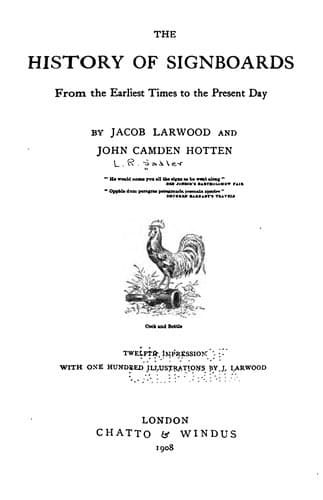
The History of Signboards, from the Earliest times to the Present DayHotten, John Camden
History
The History of Signboards, from the Earliest times to the Present Day
Hotten, John Camden
Inn signs -- England -- History; Signs and signboards -- History
The variously-coloured lions come under the same category of heraldic
animals. Amongst them the GOLDEN LION stands foremost. A public-house
with that sign in Fulham ought not to be passed unnoticed; it is one of
the most ancient houses in the village, having been built in the reign
of Henry VII. The interior is not much altered; the chimney-pieces are
in their original state, and in good preservation. Formerly there were
two staircases in the thick walls, but they are now blocked up.
Tradition says that the house once belonged to Bishop Bonner, and that
it has subterraneous passages communicating with the episcopal palace.
When the old hostelry was pulled down in 1836, a tobacco-pipe of ancient
and foreign fashion was found behind the wainscot. The stem was a
crooked bamboo, and a brass ornament of an Elizabethan pattern formed
the bowl of the pipe. This pipe Mr Crofton Croker[193] tries to identify
as the property of Bishop Bonner, who, on the 15th June 1596, died
suddenly at Fulham, “while sitting in his chair and smoking tobacco.” If
Mr Croker be right, this inn should also have been honoured by the
presence of Shakespeare, Fletcher, Henry Condell, (Shakespeare’s fellow
actor,) John Norden, (author of A Description of Middlesex and
Hertfordshire,) Florio, the translator of Montaigne, and divers other
notabilities.
The BLUE LION is far from uncommon, and may possibly have been first put
up at the marriage of James I. with Anne of Denmark. The PURPLE LION
occurs but once--namely, on a trades token of Southampton Buildings.
Signs borrowed from Corporation arms form the last subdivision of this
chapter. Such, for instance, is the THREE COMPASSES, a change in the
arms of both the carpenters and masons. This sign is a particular
favourite in London, where not less than twenty-one public-houses make a
living under its shadow. Perhaps this is partly owing to the compasses
being a masonic emblem, and a great many publicans “worthy brethren.”
Frequently the sign of the compasses contains between the legs the
following good advice:--
“Keep within compass,
And then you’ll be sure,
To avoid many troubles
That others endure.”
Three Compasses were a frequent sign with the French, German, and Dutch
printers of the sixteenth century. The Three Compasses, Grosvenor Row,
Pimlico, a well-known starting point for the Pimlico omnibuses, was
formerly called the GOAT AND COMPASSES, for which Mr P. Cunningham
suggests the following origin:--
Public-domain text, read in full here on John Shaqi.
Reviews
Reviews
No reviews yet
Be the first to share your thoughts on this work.
Elsewhere in the archive
Join the Discussion
Join the discussion
Sign in to leave a comment or review.
Sign InorCreate an account