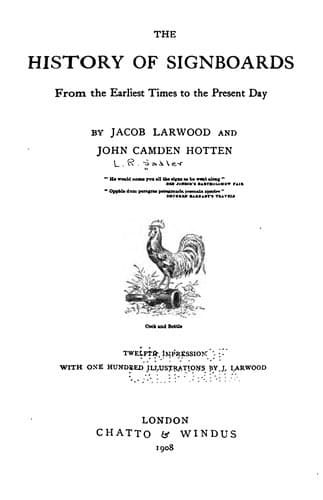
The History of Signboards, from the Earliest times to the Present DayHotten, John Camden
History
The History of Signboards, from the Earliest times to the Present Day
Hotten, John Camden
Inn signs -- England -- History; Signs and signboards -- History
“At Cologne, in the church of S. Maria di Capitolio, is a flat stone
on the floor, professing to be the ‘Grabstein der Bruder und Schwester
eines Ehrbahren Wein und Fass Ampts, Anno 1693.’ That is, as I
suppose, a vault belonging to the Wine Cooper’s Company. The arms
exhibit a shield with a pair of compasses, an axe, and a dray or
truck, with goats for supporters. In a country like England, dealing
so much at one time in Rhenish wine, a more likely origin for such a
sign could hardly be imagined.”
Others have considered the sign a corruption of a puritanical phrase,
“God encompasseth us.” But why may not the Goat have been the original
sign, to which mine host added his masonic emblem of the compasses, a
practice yet of frequent occurrence.
The GLOBE AND COMPASSES seems to have originated in the Joiners’ arms,
which are a chevron between two pairs of compasses and a globe. It
occurs, amongst other instances, as the sign of a bookseller, in the
following quaint title:--
“Sin discovered to be worse than a Toad; sold by Robert Walton, at the
_Globe and Compasses_, at the West end of Saint Paul’s Church.”
The THREE GOATSHEADS, a public-house on the Wandsworth Road, Lambeth,
was originally the Cordwainers’ (shoemakers) arms, which are azure, a
chevron or, between three goats’ heads, erased argent. Gradually the
heraldic attributes have fallen away, and the goats’ heads now alone
remain. As there were rarely names under the London signs, the public
unacquainted with heraldry gave a vernacular to the objects represented.
Thus the THREE LEOPARDS’ HEADS is given on a token as the name of a
house in Bishopsgate; yet the token represents a chevron between three
leopards’ heads, the arms of the Weavers’ Company. The sign of the
Leopard’s Head was anciently called the _Lubber’s Head_. Thus in the
second part of Henry IV., ii. 1, the hostess says that Falstaff “is
indited to dinner at the Lubbar’s Head in Lumbert Street, to Master
Smooth’s the silkman.” “Libbard,” _vulgo_ “lubbar,” was good old English
for “leopard.”
The GREEN MAN AND STILL is a common sign. There is one in White Cross
Street, representing a forester drinking what is there called “drops of
life” out of a glass barrel. This is a liberty taken with the
Distillers’ arms, which are a fess wavy in chief, the sun in splendour,
in base a still; supporters two Indians, with bows and arrows. These
Indians were transformed by the painters into wild men or green men, and
the green men into foresters; and then it was said that the sign
originated from the partiality of foresters for the produce of the still
The “drops of life,” of course, are a translation of _aqua vitæ_.
The THREE TUNS were derived from the Vintners, or the Brewers’ arms. On
the 9th of May 1667, the Three Tuns in Seething Lane was the scene of a
frightful tragedy:--
Public-domain text, read in full here on John Shaqi.
Reviews
Reviews
No reviews yet
Be the first to share your thoughts on this work.
Elsewhere in the archive
Join the Discussion
Join the discussion
Sign in to leave a comment or review.
Sign InorCreate an account