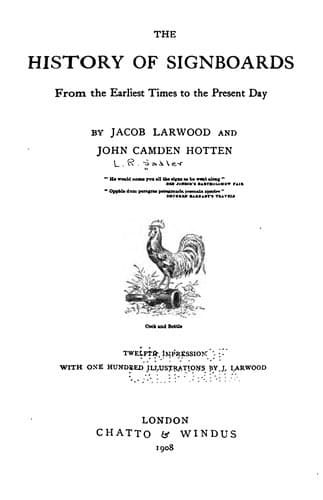
The History of Signboards, from the Earliest times to the Present DayHotten, John Camden
History
The History of Signboards, from the Earliest times to the Present Day
Hotten, John Camden
Inn signs -- England -- History; Signs and signboards -- History
[193] In 1847, Mr Crofton Croker read a paper at a meeting of the Brit.
Arch. Assoc. at Warwick, “On the probability of the Golden Lion Inn at
Fulham having been frequented by Shakespeare about the year 1595 and
1596,” in which the possible genealogy of this pipe is given.
[194] Pepys here makes a mistake, for he tells as afterwards, July 4,
when he went to the Session House to hear the trial, that Basil was the
murdered man.
[195] Caulfield’s Memoirs of Remarkable Persons. A curious epitaph upon
her occurs in the _Weekly Oracle_, February 1, 1735; unfortunately it is
too highly spiced to be introduced here.
CHAPTER IV.
SIGNS OF ANIMALS AND MONSTERS.
It is in many cases impossible to draw a line of demarcation between
signs borrowed from the animal kingdom and those taken from heraldry: we
cannot now determine, for instance, whether by the White Horse is meant
simply an _equus caballus_, or the White Horse of the Saxons, and that
of the House of Hanover; nor, whether the White Greyhound represented
originally the supporter of the arms of Henry VII., or simply the
greyhound that courses “poor puss” on our meadows in the hunting-season.
For this reason this chapter has been placed as a sequel to the heraldic
signs.
As a rule, fantastically coloured animals are unquestionably of heraldic
origin: their number is limited to the Lion, the Boar, the Hart, the
Dog, the Cat, the Bear, and in a few instances the Bull; all other
animals were generally represented in what was meant for their natural
colours. The heraldic lions have already been treated of in the last
chapter; but sometimes we meet with the lion as a _fera naturæ_,
recognisable by such names as the BROWN LION, the YELLOW LION, or simply
the Lion. There is a public-house in Philadelphia with the sign of the
Lion, having underneath the following lines:
“The lion roars, but do not fear,
Cakes and beer sold here.”
Which inscription is certainly as unnecessary as that over the
nonformidable-looking lions under the celebrated fountain in the Spanish
Alhambra, “O thou who beholdest these lions crouching, fear not, life is
wanting to enable them to exhibit their fury.”
Lions occur in numerous combinations with other animals and objects,
which in many cases seem simply the union of two signs, as the LION AND
DOLPHIN, Market Place, Leicester; the LION AND TUN, at Congleton: the
LION AND SWAN in the same locality may owe its joint title to the name
of the street in which the public-house is situated, viz., Swanbank. The
combination of the LION AND PHEASANT, Wylecop, Shrewsbury, seems rather
mysterious, unless the Pheasant has been substituted for the Cock, just
as in the THREE PHEASANTS AND SCEPTRE, they were substituted for the
THREE PIGEONS AND SCEPTRE. As for the COCK AND LION, a very common
sign, their meeting, if we may believe ancient naturalists, is anything
but agreeable to the lion.
Public-domain text, read in full here on John Shaqi.
Reviews
Reviews
No reviews yet
Be the first to share your thoughts on this work.
Elsewhere in the archive
Join the Discussion
Join the discussion
Sign in to leave a comment or review.
Sign InorCreate an account