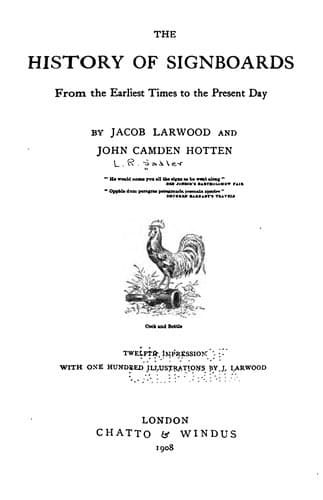
The History of Signboards, from the Earliest times to the Present DayHotten, John Camden
History
The History of Signboards, from the Earliest times to the Present Day
Hotten, John Camden
Inn signs -- England -- History; Signs and signboards -- History
“The lyon dreadeth the white cocke, because he breedeth a precious
stone called allectricium, like to the stone that hight Calcedonius.
And for that the Cocke beareth such a stone, the Lyon specially
abhorreth him.”[196]
Some more information about this stone may be gathered from a mediæval
treatise on natural history:
“Allectorius est lapis obscuro cristallo sĩlis e vẽtriculo galli
castrati trahitur post quartũ añũ. Ultima eius quãtitas ẽ ad
magnitudinẽ fabe--quẽ gladiator. hñs in ore penanct̃. ĩvictus ac sine
siti.”[197]
The LION AND BALL owes its origin to another mediæval notion:
“Some report that those who rob the tiger of her young use a policy to
detaine their damme from following them, by casting sundry
looking-glasses in the way, whereat she useth to long to gaze, whether
it be to beholde her owne beauty or because when she seeth her shape
in the glasse she thinketh she seeth one of her young ones, and so
they escape the swiftness of her pursuit.”[198]
The looking-glass thrown to the tiger was spherical, so that she could
see her own image reduced as it rolled under her paw, and would
therefore be more likely to mistake it for her cub. Lions and tigers
being almost synonymous in mediæval zoology, the spherical glass was
generally represented with both. In sculpture it could only be
represented by a ball, which afterwards became a terrestrial globe, and
the lion resting his paw upon it, passed into an emblem of royalty.
In the last century an innkeeper at Goodwood put up as his sign the
CENTURION’S LION, the figure-head of the frigate _Centurion_, in which
Admiral Anson made a voyage round the world. Under it was the following
inscription:--
“Stay, Traveller, a while and view
One that has travelled more than you,
Quite round the Globe in each Degree,
Anson and I have plow’d the Sea;
Torrid and Frigid Zones have pass’d,
And safe ashore arriv’d at last.
In Ease and Dignity appear
He--in the House of Lords, I--here.”
When Anson was in general disfavour about the Minorca affair, the
following biting reply to this inscription went the round of the
newspapers:--
“_The Traveller’s reply to the Centurion’s Lion._
“O King of Beasts, what pity ’twas to sever
A pair whose Union had been just for ever!
So diff’rently advanced! ’twas surely wrong,
When you’d been fellow-travellers so long.
Had you continued with him, had he born
To see the English Lion dragg’d and torn?
Brittannia made at every vein to bleed,
A ravenous Crew of worthless Men to feed?
No; Anson once had sought the Land’s Relief;
Now--Ease and Dignity have banish’d Grief.
Go, rouse him then, to save a sinking nation,
Or call him up, the partner of your station.
We often see two Monsters for a sign,
Inviting to good Brandy, Ale, or Wine.”
Public-domain text, read in full here on John Shaqi.
Reviews
Reviews
No reviews yet
Be the first to share your thoughts on this work.
Elsewhere in the archive
Join the Discussion
Join the discussion
Sign in to leave a comment or review.
Sign InorCreate an account