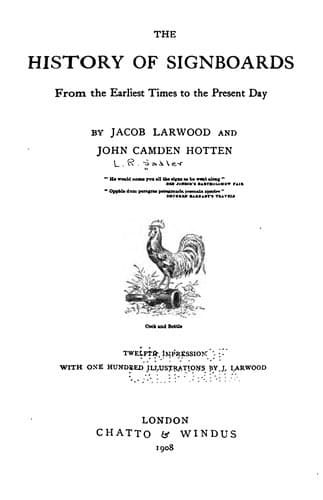
The History of Signboards, from the Earliest times to the Present DayHotten, John Camden
History
The History of Signboards, from the Earliest times to the Present Day
Hotten, John Camden
Inn signs -- England -- History; Signs and signboards -- History
The WHITE BEAR at Soper’s Lane End, (now Queen Street,) Cheapside, was
the shop in which Baptist Hicks, as a silk mercer, by selling silks,
velvets, lace, and plumes to the courtiers of James I., amassed that
fortune which led to the Peerage, and the title of Viscount Campden.
There was another White Bear Tavern in Thames Street, of which the sign
is still extant, a stone bas-relief with the date 1670, and the initials
M. E. In 1252, Henry III. received a white bear as a present from the
king of Norway; and in King Edward VI.’s time, May 29, 1549, the French
ambassadors, after they had supped with the Duke of Somerset, went to
the Thames and saw the bear hunted in the river.[202] Such an occurrence
might easily lead to the adoption of this animal as a sign in that
locality. The following little fact connected with another White Bear
Inn forcibly calls up the _dark_ ages before gas was invented. In 1656,
John Wardall gave by will to the Grocers’ Company a tenement called “The
White Bear in Walbrook,” upon condition that they should yearly pay to
the church-wardens of St Botolph’s, Billingsgate, £4 to provide a
lanthorn with a candle, so that passengers might go with more security
to and from the waterside during the night. This lamp was to be fixed at
the north-east corner of the parish church of St Botolph, from St
Bartholomew’s-day to Lady-day; out of this sum £1 was to be paid to the
sexton for taking care of the lanthorn. The annuity is now applied to a
lamp lighted with gas in the place prescribed by the will.[203]
The White Bear Inn, at the east end of Piccadilly, was for more than a
century one of the busiest coaching houses. In this house died Luke
Sullivan, engraver of some of Hogarth’s works; also Chatelain, another
engraver, the last in such penurious circumstances, that he was buried
at the expense of some friends in the poor ground of St James’s
workhouse. It was in this inn that West passed the first night in London
on his arrival from America. The sign of the White Bear is still common;
at Springbank, Hull, there is one called, with zoological precision, the
POLAR BEAR. This may, however, refer to the constellation.
Public-domain text, read in full here on John Shaqi.
Reviews
Reviews
No reviews yet
Be the first to share your thoughts on this work.
Elsewhere in the archive
Join the Discussion
Join the discussion
Sign in to leave a comment or review.
Sign InorCreate an account