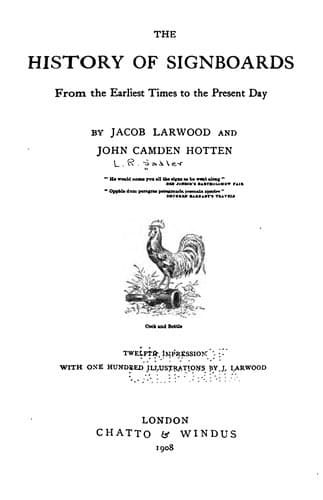
The History of Signboards, from the Earliest times to the Present DayHotten, John Camden
History
The History of Signboards, from the Earliest times to the Present Day
Hotten, John Camden
Inn signs -- England -- History; Signs and signboards -- History
The BEAR’S HEAD occurs in Congleton, Cheshire; probably it is a family
crest, the same as the BEAR’S PAW,--both of which, it is believed, occur
only in that county and in Lancashire. The Bear is also met in frequent
combinations; one of the most common is the BEAR AND BACCHUS, which
looks like a hieroglyphic rendering of the words Beer and Wine, having
the additional attraction of alliteration. Since mythology does not
mention a Beer-God, the animal was probably chosen as a rebus for the
drink. In the BEAR AND RUMMER, Mortimer Street, the rummer implies the
sale of liquors, in the same manner as the Punchbowl is often used. The
BEAR AND HARROW seems to be a union of two signs. In the seventeenth
century it formed the house-decoration of an ordinary at the entrance of
Butcher Row, (now Picket Street, Strand.) One night in 1692, Nat Lee,
the mad poet, in going home drunk from this house, fell down in the snow
and was stifled.
The Elephant, in the middle ages, was nearly always represented with the
castle on his back. For instance, in the Latin MS., Bestiarium Harl.,
4751, a tower is strapped to him, in which are seen five knights in
chain-armour, with swords, battle-axes, and cross-bows, their emblazoned
shields hanging round the battlements; and, in the description of the
animal, it is said, “In eorum dorsis, P[er] si et Indi ligneis turribus
collocati tamquam de muro jaculis dimicant.” The rook, in Chinese
chess-boards, still represents an elephant thus armed.
Cutlers in the last century frequently used the ELEPHANT AND CASTLE as
their sign, on account of it being the crest of the Cutlers’ Company,
who had adopted it in reference to the ivory used in the trade. Hence
the stone bas-relief in Belle Sauvage Yard, which was the sign of some
now forgotten shopkeeper, who had chosen it out of regard to his
landlords. The houses in the yard are the property of the Cutlers’
Company. The ELEPHANT AND CASTLE public-house, Newington Butts, was
formerly a famous coaching inn, but, by the introduction of railways, it
has dwindled down to a starting-point for omnibuses. The occasion of
this sign being put up was the following:--Some time about 1714, a Mr
Conyers, an apothecary in Fleet Street, and a great collector of
antiquities, was digging in a gravel-pit in a field near the Fleet, not
far from Battle Bridge, when he discovered the skeleton of an elephant.
A spear with a flint head, fixed to a shaft of goodly length, was found
near it, whence it was conjectured to have been killed by the British in
a fight with the Romans,[204] though now, since the late discoveries
concerning the flint implements, very different conclusions would be
drawn from this fact. But be this as it may, that elephant, whether
post-tertiary or Roman, gave its name to the public-house soon after
erected in that locality; and, regardless of the venerable antiquity of
this origin, it is often now-a-days jocularly degraded into the PIG AND
TINDER-BOX.
Public-domain text, read in full here on John Shaqi.
Reviews
Reviews
No reviews yet
Be the first to share your thoughts on this work.
Elsewhere in the archive
Join the Discussion
Join the discussion
Sign in to leave a comment or review.
Sign InorCreate an account