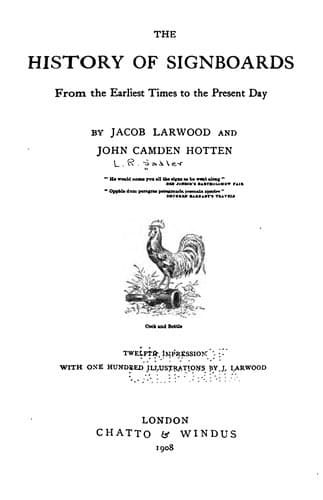
The History of Signboards, from the Earliest times to the Present DayHotten, John Camden
History
The History of Signboards, from the Earliest times to the Present Day
Hotten, John Camden
Inn signs -- England -- History; Signs and signboards -- History
What is meant by the whimsical combination of the ELEPHANT AND FISH, at
Sandhill, Newcastle, is hard to say, unless we assume the fish
originally to have been a dragon. Between elephants and dragons there
was supposed to be a deadly strife, and their battles are recorded by
Strabo, Pliny, Ælianus, and their mediæval followers. The fight always
ended in the death of both, the dragon strangling the elephant in the
windings of his tail, when the elephant, falling down dead, crushed the
dragon by his weight.
The ELEPHANT AND FRIAR, in Bristol, may possibly have originated from
the representation of an elephant accompanied by a man in Eastern
costume, whose flowing garment might be mistaken for the gown of a
friar. That sign would have admirably suited the fancy of the landlord
of the Elephant and Castle, formerly in Leeds; his name happening to be
Priest, he had the following inscription above his door:
“He is a priest who lives within,
Gives advice gratis, and administers gin.”
In the seventeenth century, the REINDEER began to make its appearance on
the signboard, where it has kept its place to the present day. At first
it was called _Rained Deer_, as we see from the newspapers of that
period:--“Mr John Chapman, York carrier in Hull, at the sign of the
Rained Deer.” This led to the answer of a sailor who had made a voyage
to Lapland, and on his return, being asked if he had seen any rained
deer? “No,” answered Jack, “I have seen it rain cats, dogs, and
pitchforks, but I never saw it rain deer.” The first instance we find of
this animal on the signboards of London, is in 1682, when there was
“Right Irish Usquebaugh to be sold at the Reindeer in Tuttle Street,
Westminster, in greater or smaller quantities, by one from
Ireland.”--_London Gazette_, Nov. 23-27, 1682.
Pepys mentions it as early as October 7, 1667, at Bishop Stortford, as
the sign of a tavern kept by a Mrs Elizabeth Aynsworth. Of this woman a
good story is told:--Mrs A. had been a noted procuress at Cambridge, for
which reason she was expelled the town by the University authorities.
Subsequently keeping the Reindeer at Bishop Stortford, the
Vice-chancellor and some of the heads of colleges, on their way to
London, had occasion to sleep at her house, little thinking under whose
roof they were. She received them nobly, served the supper up in plate,
and brought forth the best wine; but, when the hour of reckoning came,
would receive no money, “for,” said she, “I am too much indebted to the
Vice-chancellor for expelling me from Cambridge, which has been the
means of making my fortune.” For all this, however, she does not seem to
have mended her evil courses, for, shortly after, she was implicated in
the murder of a Captain Wood in Essex, for which one man was executed,
whilst Mrs Aynsworth was only acquitted by some flaw in the evidence.
Public-domain text, read in full here on John Shaqi.
Reviews
Reviews
No reviews yet
Be the first to share your thoughts on this work.
Elsewhere in the archive
Join the Discussion
Join the discussion
Sign in to leave a comment or review.
Sign InorCreate an account