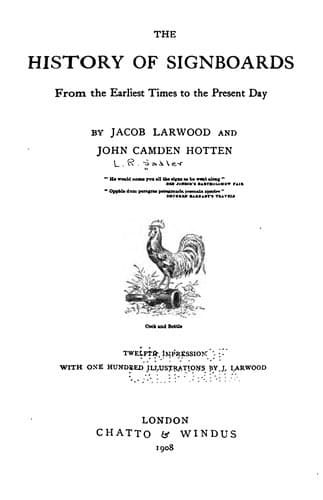
The History of Signboards, from the Earliest times to the Present DayHotten, John Camden
History
The History of Signboards, from the Earliest times to the Present Day
Hotten, John Camden
Inn signs -- England -- History; Signs and signboards -- History
This incombustibility made it a very proper sign for alchemists and
apothecaries, and with the last it still continues as such, at least on
the Continent. Why the early Venetian printers adopted it as a sign is
less evident. In France it was certainly a favourite sign with this
class of workmen; but this was from the fact of its having been the
badge of Francis I., a liberal patron of the arts and sciences.
The qualities attributed to the UNICORN caused this animal to be used as
a sign both by chemists and goldsmiths. It was believed that the only
way to capture it was to leave a handsome young virgin in one of the
places where it resorted. As soon as the animal had perceived her, he
would come and lie quietly down beside her, resting his head in her lap,
and fall asleep, in which state he might be surprised by the hunters who
watched for him. This laying his head in the lap of a virgin made the
first Christians choose the unicorn as the type of Christ born from the
Virgin Mary.[210] The horn, as an antidote to all poison, was also
believed to be emblematic of the conquering or destruction of sin by the
Messiah. Religious emblems being in great favour with the early
printers, some of them for this reason adopted the unicorn as their
sign; thus John Harrison lived at the UNICORN AND BIBLE in Paternoster
Row 1603. Again, the reputed power of the horn caused the animal to be
taken as a supporter for the apothecaries’ arms, and as a constant
signboard by chemists. Albertus Magnus says:--“Cornu cerastis sunt qui
dicunt præsenti veneno sudare et ideo ferri ad mensas nobilium, et fieri
inde manubria cultellorum quæ infixa mensis prodant presens venenum.
Sed hoc non satis probatum est.”[211] Whatever it was that passed for
unicorn’s horn, (probably the horn of the narwal,) it was sold at an
immense price. “The unicorn whose horn is worth a city,” says Decker in
his Gull’s Hornbook; and Andrea Racci, a Florentine physician, relates
that it had been sold by the apothecaries at £24 per ounce, when the
current value of the same quantity of gold was only £2, 3s. 6d. In a MS.
table of customs entitled, “The Book of Rates in y^{e} first yeare of
Queen Mary 1531,”[212] we find the duty paid upon “cornu unicorn y^{e}
ounce 20s.” An Italian author who visited England in the reign of Henry
VII.,[213] speaking of the immense wealth of the religious houses in
this country says:--“And I have been informed that, amongst other
things, many of these monasteries possess unicorns’ horns of an
extraordinary size.” Hence such a horn was fit to be placed among the
royal jewels, and there it appears at the head of an inventory taken in
the first year of Queen Elizabeth, and preserved in Pepys’s
library.[214] “Imprimis, a piece of unicorn’s horn,” which, as the most
valuable object, is named first.
Public-domain text, read in full here on John Shaqi.
Reviews
Reviews
No reviews yet
Be the first to share your thoughts on this work.
Elsewhere in the archive
Join the Discussion
Join the discussion
Sign in to leave a comment or review.
Sign InorCreate an account