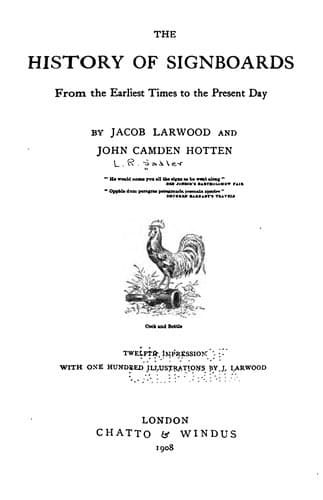
The History of Signboards, from the Earliest times to the Present DayHotten, John Camden
History
The History of Signboards, from the Earliest times to the Present Day
Hotten, John Camden
Inn signs -- England -- History; Signs and signboards -- History
This was no doubt the piece seen by the German traveller Hentzner, at
Windsor: “We were shown here, among other things, the horn of a unicorn
of above eight spans and a half in length, valued at above
£10,000.”[215] Peacham places “that horne of Windsor (of an unicorne
very likely)”[216] amongst the sights worth seeing. Fuller also speaks
of a unicorn’s horn--“in my memory shewn to people in the
Tower”[217]--and enters on a long dissertation about its virtues; but it
seems to have been lost, or at least, no longer exhibited in his time.
The belief in the efficacy and value of this horn continued to the close
of the seventeenth century; for the Rev. John Ward in his diary, p. 172,
says:--
“Mr Hartman had a piece of unicorn’s horn, which one Mr Godeski gave
him; hee had itt att some foraine prince’s court. I had the piece in
my hand. Hee desired Dr Willis to make use of itt in curing his ague;
but the Dr refusd because hee had never seen itt used. Mr Hartman told
me the forementioned gentleman has as much of itt as would make a cup,
and he intended to make one of itt. It approved ittself as a true one,
as he said by this: if one drew a circle with itt about a spider, she
would not move out off itt.”[218]
[Illustration: PLATE VIII.
TWO SPIES.
(Banks’s Collection, 1730.)
THREE NEATS’ TONGUES.
(Harleian Collection, 1708.)
MAN IN THE MOON.
(Banks’s Collection, 1760.)
BULL AND MOUTH.
(St Martin’s-le-Grand, 1835.)
BULL AND MOUTH.
(Angel St., St Martin’s-le-Grand, circa 1800.)]
The great value set upon unicorns’ horn caused the goldsmiths to adopt
this animal as their sign. There is one recorded in Machyn’s Diary: the
first of May 1561, “at afternone dyd Mastyr Godderyke’s sune the
goldsmyth go hup into hys father’s gyldyng house, toke a bowe-strynge,
and hanged ymseylff at the syne of the Unycorne in Chepesyd.” In 1711
the UNICORN AND DIAL was the sign of a watchmaker near the Strand
Bridge.[219]
Another fabulous animal that formerly (though rarely) occurred on
signboards was the COCKATRICE, which was the sign of a place of
amusement in Highbury _circa_ 1611. The “Bestiaria,” or ancient natural
histories, give most extraordinary particulars about the birth of this
creature:--
Public-domain text, read in full here on John Shaqi.
Reviews
Reviews
No reviews yet
Be the first to share your thoughts on this work.
Elsewhere in the archive
Join the Discussion
Join the discussion
Sign in to leave a comment or review.
Sign InorCreate an account