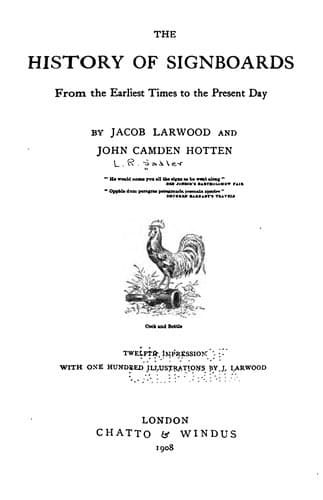
The History of Signboards, from the Earliest times to the Present DayHotten, John Camden
History
The History of Signboards, from the Earliest times to the Present Day
Hotten, John Camden
Inn signs -- England -- History; Signs and signboards -- History
“When the cock is past seven years old an egg grows in his belly, and
when he feels this egg, he wonders very much, and sustains the
greatest anxiety any animal can suffer. He seeks, privately, a warm
place on a dunghill or in a stable, and scratches with his feet, until
he has formed a hole to lay his egg in. And when the cock has dug his
hole he goes ten times a day to it, for all day he thinks that he is
going to be delivered. And the nature of the toad is such that it
smells the venom which the cock carries in his belly, consequently it
watches him, so that the cock cannot go to the hole without being seen
by it. And as soon as the cock leaves the place where he has to lay
his egg, the toad is immediately there to see if the egg has been
laid; for his nature is such, that he hatches the egg if he can obtain
it. And when he has hatched it, until it is time to open, it produces
an animal that has the head, and neck, and breast of a cock, and from
thence downwards, the body of a serpent.”--_Translation from the MS.
Bestiarium_, Bib. Roy. Brussels, No. 10074.
That cocks, sometimes in the middle ages, forgot themselves so far as to
lay eggs, appears from a lawsuit which poor chanticleer had at Basle in
1474, when he was convicted, condemned, and, with his egg, burned at the
stake for a sorcerer, with as much pomp and ceremony as if he had been a
Protestant or other heretic.
The APE was, in bygone times, the sign of an inn in Philip Lane, near
London wall; all that now remains of this ancient hostelry is a stone
carving of a monkey squatted on its haunches, and eating an apple; under
it the date 1670, and the initial B. The courtyard, where the lumbering
coaches used to arrive and depart, is now an open space, round which
houses are built. The RACOON is a painted sign at Dalston, but a hyæna
seems to have sat for the portrait; the HIPPOPOTAMUS occurs in
New-England Street, Brighton; the IBEX at Chadelworth, Wantage; the
CROCODILE in Higham Street, Norwich; the CAMEL may be met with in a few
instances, and at Weston Peverell, Plymouth, there is the sign of the
CAMEL’S HEAD. Finally, there is the KANGAROO, of which, occasionally, an
example may be seen, set up probably by some landlord who had tried his
luck in Australia. The CIVET is common all over Europe as a perfumer’s
sign, as it was said to produce musk. A Dutch perfumer in the
seventeenth century wrote under his sign:--
“Dit ’s in de Civet kat, gelyk gy kunt aanschouwen,
Maar komt hier binnen, hier zyn parfuimen voor mannen en
vrouwen.”[220]
The HEDGEHOG was never very common. In the reign of Queen Elizabeth it
was the sign of William Seeres, bookseller, in St Paul’s Churchyard, who
put it up, according to Bagford, on account of its being the badge of
his former master Sir Henry Sydney.[221] Apparently this same house was
concerned in the following strange affair:--
Public-domain text, read in full here on John Shaqi.
Reviews
Reviews
No reviews yet
Be the first to share your thoughts on this work.
Elsewhere in the archive
Join the Discussion
Join the discussion
Sign in to leave a comment or review.
Sign InorCreate an account