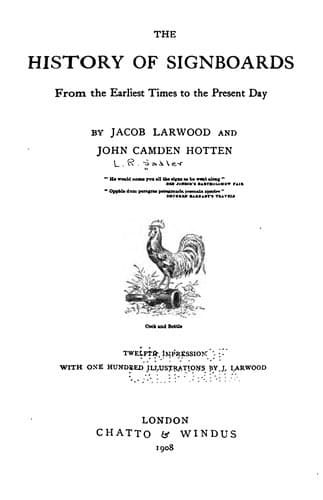
The History of Signboards, from the Earliest times to the Present DayHotten, John Camden
History
The History of Signboards, from the Earliest times to the Present Day
Hotten, John Camden
Inn signs -- England -- History; Signs and signboards -- History
“By a lettere dated London, 11 May 1555, it appears that in Powles
Churchyearde at the sign of the Hedgehog, the goodwife of the house
was brought to bed of a manchild, being of the age of 6 dayes and
dienge the 7^{th} daye followinge; and half an hour before it departed
spake these words followinge: (rise and pray) and so continued half an
houre in thes words and then cryinge departed the worlde. Hereupon the
Bishope of London examined the goodman of the house and other credible
persones who affirmed it to be true and will dye uppon the same.”[222]
The Hedgehog is now very scarce on signboards; at Dadlington, near
Market Bosworth, there is a DOG AND HEDGEHOG, doubtless borrowed from
the well-known engraving of “A Rough Customer.”
Signs relating to sport or the chase are comparatively common; thus we
have the RAT AND FERRET at Wilson, near Ashby de la Zouch; the THREE
CONIES, or rabbits, figure on an old trades token of Blackman Street;
the HARE, on the token of John Perris in the Strand, 1666; and Nicholas
_Warren_, in Aldersgate.[223] Warren evidently made a cockney mistake,
thinking that hares, instead of rabbits, lived in _warrens_. Another
Hare was the sign of Philip Hause in Walbrook in 1682.[224] The HARE AND
SQUIRREL occur together on a sign at Nuneaton; what the combination
means it is difficult to surmise.
“Cages with climbing SQUIRRELS and bells to them were formerly the
indispensable appendages of the outside of a Tinman’s shop, and were,
in fact, the only live sign. One, we believe, still (1826) hangs out
on Holborn; but they are fast vanishing with the good old modes of our
ancestors.”[225]
The THREE SQUIRRELS was the sign of an inn at Lambeth, mentioned by
Taylor the Water poet in 1636; and from a trades token it appears that
in the seventeenth century there was a similar sign in Fleet Street.
Probably it was the same house which, in 1673/4, was occupied by Gosling
the banker, “over against St Dunstan’s Church,” where the triad of
squirrels may still be seen in the iron-work of the windows. Gosling’s
was one of the leading banking establishments in the reign of Charles
II. Among the curiosities of this old firm is a bill for £640, 8s., paid
out of the secret service money for gold lace and silver lace, bought by
the Duchess of Cleveland for the wedding clothes of the Lady Sussex and
Litchfield.
The HARE AND HOUNDS are very common; some fifty years ago it was the
sign of a notorious establishment in St Giles’s, one of those places
associated with “the good old customs of our ancestors.” As the few
houses of this character that remain are difficult of access, a
description of this place may not be uninteresting.
Public-domain text, read in full here on John Shaqi.
Reviews
Reviews
No reviews yet
Be the first to share your thoughts on this work.
Elsewhere in the archive
Join the Discussion
Join the discussion
Sign in to leave a comment or review.
Sign InorCreate an account