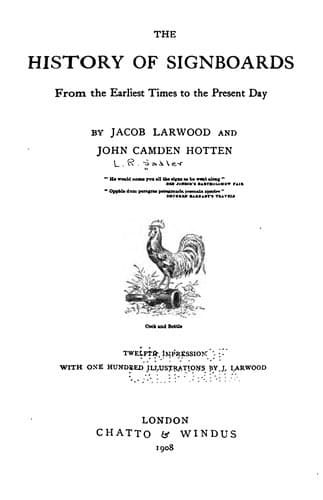
The History of Signboards, from the Earliest times to the Present DayHotten, John Camden
History
The History of Signboards, from the Earliest times to the Present Day
Hotten, John Camden
Inn signs -- England -- History; Signs and signboards -- History
“The Hare and Hounds was to be reached by those going from the west
end towards the city, by going up a turning on the left hand, nearly
opposite St Giles’s churchyard. The entrance to this turning or lane
was obstructed or defended by posts with cross bars, which being
passed, the lane itself was entered. It extended some twenty or thirty
yards towards the north, through two rows of the most filthy,
dilapidated, and execrable buildings that could be imagined; and at
the top or end of it stood the citadel, of which ’Stunning Joe’ was
the corpulent castellan;--I need not say that it required some
determination and some address to gain this strange place of
rendezvous. Those who had the honour of an introduction to the great
man were considered safe, wherever his authority extended, and in
this locality it was certainly very extensive. He occasionally
condescended to act as a pilot through the navigation of the alley to
persons of aristocratic or wealthy pretensions, whom curiosity, or
some other motive best known to themselves, led to his abode. Those
who were not under his safe conduct frequently found it very unsafe to
wander in the intricacies of this region. In the _salon_ of this
temple of low debauchery were assembled groups of all ‘unutterable
things,’ all that class distinguished in those days, and, I believe,
in these, by the generic term ‘cadgers.’
Hail cadgers, who in rags array’d,
Disport and play fantastic pranks;
Each Wednesday night in full parade,
Within the domicile of Bank’s.
A ‘lady’ presided over the revels, collected largess in a platter,
and, at intervals, amused the company with specimens of her vocal
talent. Dancing was ‘kept up till a late hour,’ with more vigour than
elegance, and many terpsichorean passages, which partook rather of the
animation of the ‘Nautch’ than the dignity of the minuet, increased
the interest of the performance. It may be supposed that those who
assembled were not the sort of people who would have patronised Father
Matthew had he visited St Giles’s in those times. There was indeed an
almost incessant complaint of drought, which seemed to be increased by
the very remedies applied for its cure; and had it not been for the
despotic authority with which the dispenser of the good things of the
establishment exercised his rule, his liberality in the dispensation
would certainly have led to very vigorous developments of the
reprobation of man and of woman also. In the lower tier, or cellars,
or crypt of the edifice, beds or berths were provided for the company,
who, packed in bins after the ‘fitful fever’ of the evening, slept
well.”[226]
In 1750 there was a sign of the HARE AND CATS at Norwich,[227] which was
clearly a travesty of the Hare and Hounds.
Public-domain text, read in full here on John Shaqi.
Reviews
Reviews
No reviews yet
Be the first to share your thoughts on this work.
Elsewhere in the archive
Join the Discussion
Join the discussion
Sign in to leave a comment or review.
Sign InorCreate an account