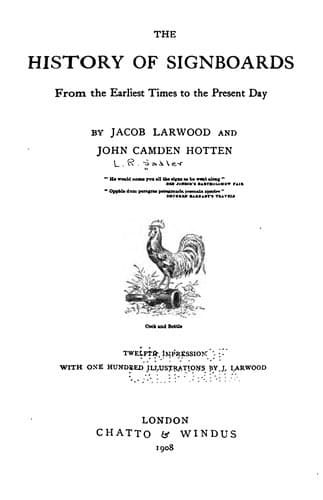
The History of Signboards, from the Earliest times to the Present DayHotten, John Camden
History
The History of Signboards, from the Earliest times to the Present Day
Hotten, John Camden
Inn signs -- England -- History; Signs and signboards -- History
At the time of the great Civil War, house-signs played no inconsiderable
part in the changes and convulsions of the state, and took a prominent
place in the politics of the day. We may cite an earlier example, where
a sign was made a matter of high treason--namely, in the case of that
unfortunate fellow in Cheapside, who, in the reign of Edward IV., kept
the sign of the Crown, and lost his head for saying he would “make his
son heir to the Crown.” But more general examples are to be met with in
the history of the Commonwealth troubles. At the death of Charles I.,
John Taylor the water-poet, a Royalist to the backbone, boldly shewed
his opinion of that act, by taking as a sign for his alehouse in Phœnix
Alley, Long Acre, the Mourning Crown; but he was soon compelled to take
it down. Richard Flecknoe, in his “Ænigmatical Characters,” (1665,)
tells us how many of the severe Puritans were shocked at anything
smelling of Popery:--“As for the signs, they have pretty well begun
their reformation already, changing the sign of the Salutation of Our
Lady into the Souldier and Citizen, and the Catherine Wheel into the
Cat and Wheel; such ridiculous work they make of this reformation, and
so jealous they are against all mirth and jollity, as they would pluck
down the Cat and Fiddle too, if it durst but play so loud as they might
hear it.” No doubt they invented very godly signs, but these have not
come down to us.
At that time, also, a fashion prevailed which continued, indeed, as long
as the signboard was an important institution--of using house-signs to
typify political ideas. Imaginary signs, as a part of secret imprints,
conveying most unmistakably the sentiments of the book, were often used
in the old days of political plots and violent lampoons. Instance the
following:--
“VOX BOREALIS, or a Northerne Discoverie, by Way of Dialogue, between
Jamie and Willie. Amidst the Babylonians--printed by Margery
Marprelate, in Thwack Coat Lane, at the sign of the _Crab-Tree
Cudgell_, without any privilege of the Catercaps. 1641.”
“ARTICLES OF HIGH TREASON made and enacted by the late Halfquarter
usurping Convention, and now presented to the publick view for a
general satisfaction of all true Englishmen. Imprinted for Erasmus
Thorogood, and to be sold at the signe of the _Roasted Rump_. 1659.”
“A CATALOGUE OF BOOKS of the Newest Fashion, to be sold by auction at
the Whigs’ Coffeehouse, at the sign of the _Jackanapes_ in Prating
Alley, near the Deanery of Saint Paul’s.”
“THE CENSURE OF THE ROTA upon Mr Milton’s book, entitled ‘The Ready
and Easy Way to Establish a Free Commonwealth,’ &c. Printed at London
by Paul Giddy, Printer to the Rota, at the sign of the _Windmill_, in
Turn-again Lane. 1660.”
Public-domain text, read in full here on John Shaqi.
Reviews
Reviews
No reviews yet
Be the first to share your thoughts on this work.
Join the Discussion
Join the discussion
Sign in to leave a comment or review.
Sign InorCreate an account