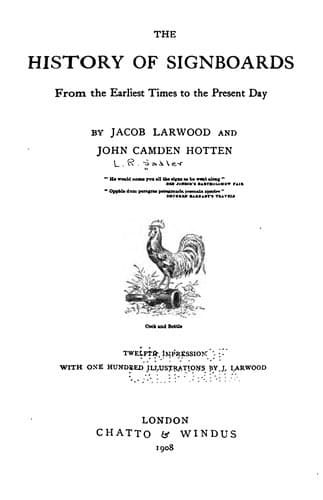
The History of Signboards, from the Earliest times to the Present DayHotten, John Camden
History
The History of Signboards, from the Earliest times to the Present Day
Hotten, John Camden
Inn signs -- England -- History; Signs and signboards -- History
Already, in very early times, publicans were compelled by law to have a
sign; for we find that in the 16 Richard II., (1393,) Florence North, a
brewer of Chelsea, was “presented” “for not putting up the usual
sign.”[18] In Cambridge the regulations were equally severe; by an Act
of Parliament, 9 Henry VI., it was enacted: “Quicunq; de villa
Cantebrigg ‘braciaverit ad vendend’ exponat signum suum, alioquin
omittat cervisiam.”--_Rolls of Parliament_, vol. v. fol. 426 a.[19] But
with the other trades it was always optional. Hence Charles I., on his
accession to the throne, gave the inhabitants of London a charter by
which, amongst other favours, he granted them the right to hang out
signboards:--
“And further, we do give and grant to the said Mayor, and Commonalty,
and Citizens of the said city, and their successors, that it may and
shall be lawful to the Citizens of the same city and any of them, for
the time being, to expose and hang in and over the streets, and ways,
and alleys of the said city and suburbs of the same, signs, and posts
of signs, affixed to their houses and shops, for the better finding
out such citizens’ dwellings, shops, arts, or occupations, without
impediment, molestation, or interruption of his heirs or successors.”
In France, the innkeepers were under the same regulations as in England;
for there also, by the edict of Moulins, in 1567, all innkeepers were
ordered to acquaint the magistrates with their name and address, and
their “affectes et enseignes;” and Henri III., by an edict of March
1577, ordered that all innkeepers should place a sign on the most
conspicuous part of their houses, “aux lieux les plus apparents;” so
that everybody, even those that could not read, should be aware of their
profession. Louis XIV., by an ordnance of 1693, again ordered signs to
be put up, and also the price of the articles they were entitled to
sell:--
“Art. XXIII.--Taverniers metront enseignes et bouchons. . . . Nul ne
pourra tenir taverne en cette dite ville et faubourgs, sans mettre
enseigne et bouchon.”[20]
Hence, the taking away of a publican’s licence was accompanied by the
taking away of his sign:--
“For this gross fault I here do damn thy licence,
Forbidding thee ever to tap or draw;
For instantly I will in mine own person,
Command the constables to pull down thy sign.”
MASSINGER, _A New Way to Pay Old Debts_, iv. 2.
Public-domain text, read in full here on John Shaqi.
Reviews
Reviews
No reviews yet
Be the first to share your thoughts on this work.
Join the Discussion
Join the discussion
Sign in to leave a comment or review.
Sign InorCreate an account