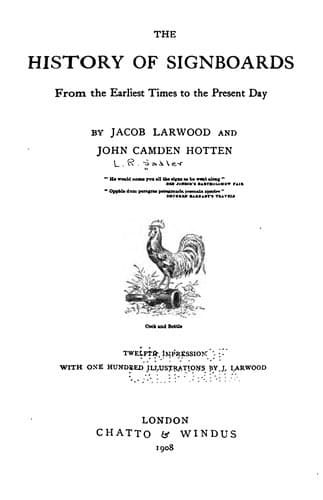
The History of Signboards, from the Earliest times to the Present DayHotten, John Camden
History
The History of Signboards, from the Earliest times to the Present Day
Hotten, John Camden
Inn signs -- England -- History; Signs and signboards -- History
Some other combinations are not so easily explained, such as the FOX AND
CAP, Long Lane, Smithfield: but when we see the bill of this shop[233]
the mystery is explained; it was the sign of Tho. Tronsdale, a capmaker,
and represented a fox running, with a cap painted above him, to intimate
the man’s business. The FOX AND CROWN, Nottingham and Newark, is
evidently a combination of two signs. The FOX AND KNOT, Snow Hill, seems
to be of old standing, as it has given its name to a court close by. Its
origin, doubtless, is exactly similar to that of the Fox and Cap; the
knot or top-knot being a head-dress worn by ladies in the last century.
The FLYING FOX at Colchester, may either allude to some kind of bat or
flying squirrel (?) thus denominated, or is a landlord’s _caprice_.
It is certainly somewhat strange that in this sporting country the sign
of the Brush or the Fox’s Tail should be so rare; in fact, no instance
of its use is now to be found, although, beside the interest attached to
it in the hunting field, it had the honour of being one of the badges of
the Lancaster family. What is still more surprising is, that the FOX’S
TAIL should have been the sign of a Parisian bookseller, Jean Ruelle, in
1540; but what prompted him to choose this sign is now rather difficult
to guess.
DOMESTIC ANIMALS.
Notwithstanding the ballad of the “Vicar and Moses,” which says,
“_At the sign of the Horse_ old Spintext of course
Each night took his pipe and his pot,”
the horse rarely or never occurs without a distinctive adjective to
determine its colour, action, or other attribute. All natural colours of
the horse, and some others, are found on the signboard--black, white,
bay, sorrel, (rare,) pied, spotted, red, sometimes golden, and in one
instance, at Grantham, a BLUE Horse is met with. Frequently the sign of
the Horse is accompanied by the following hippophile advice:--
“Up hill hurry me not;
Down hill trot me not;
On level ground spare me not;
And in the stable I’m not forgot.”
Many years ago, at Greenwich, there was a public-house with the sign of
a Horse. Behind the house was a large grass field, to which referred the
following notice, painted under the sign:--“Good Grass for Horses. LONG
TAILS three shillings and sixpence per week.” An inquisitive person
passing that way, and not understanding the meaning of the notice, went
in and questioned the landlord, who informed him that a difference was
made for the bob-tailed horses; “for,” said he, “long-tailed horses can
whisk off the flies, and eat at their leisure; but bob-tails have to
shake their heads and run about from morning till night, and so do eat
much less.”
Public-domain text, read in full here on John Shaqi.
Reviews
Reviews
No reviews yet
Be the first to share your thoughts on this work.
Elsewhere in the archive
Join the Discussion
Join the discussion
Sign in to leave a comment or review.
Sign InorCreate an account