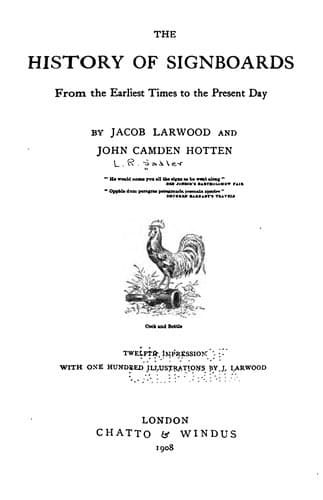
The History of Signboards, from the Earliest times to the Present DayHotten, John Camden
History
The History of Signboards, from the Earliest times to the Present Day
Hotten, John Camden
Inn signs -- England -- History; Signs and signboards -- History
The NAG’S HEAD--which only in one instance is varied by the HORSE’S
HEAD, namely, at Brampton in Cumberland--is a sign that has become
famous in history; it is represented on the print of the entry of Queen
Marie de’ Medici on her visit to her daughter Henriette Marie, Queen of
Charles I., being the sign of a notorious tavern opposite the Cheapside
Cross. It is suspended from a long square beam, at the end of which a
large crown of evergreens is seen. As none of the other houses are
decked with greens, this apparently represents the Bush.[241] This
tavern was the fictitious scene of the consecration of the Protestant
bishops at the accession of Queen Elizabeth in 1559. It was pretended by
the adversaries of the Protestant faith, that a certain number of
ecclesiastics, in a hurry to take possession of the vacant sees,
assembled here; where they were to undergo the ceremony from Antony
Kitchen, _alias_ Dunstane, Bishop of Llandaff, a sort of occasional
Nonconformist, who had taken the oath of supremacy to Elizabeth; Bonner,
Bishop of London, (then confined in the Tower,) hearing of it, sent his
chaplain to Kitchen, threatening him with excommunication in case he
proceeded. On this the prelate refused to perform the ceremony;
whereupon, according to Catholics, Parker and the other candidates,
rather than defer possession of their dioceses, determined to consecrate
one another, which they did, without any sort of scruple. Scorey began
with Parker, who instantly rose Archbishop of Canterbury. The refutation
of this tale may be read in Strype’s life of Archbishop Parker.[242]
A curious anecdote is told concerning the sign of a GELDING. Golden
Square, it appears, was originally called Gelding Square, from the sign
of a neighbouring inn; but the inhabitants, indignant at the vulgarity
of the name, changed it to its present title.
Some publicans appear to be of opinion that the GREY MARE is the best
horse for their signboards; in Lancashire, especially, this sign
abounds. Others put up the MARE AND FOAL; but they are evidently not
very well acquainted with the old ballad of the “Mare and Foal that went
to church,” for there the Mare says:--
“Oh! to pray for those publicans I am very loath,
They fill their pots full of nothing but froth,
Some fill them half full, and others the whole;
May the devil go with them!--Amen, says the foal.
Derry down,” &c.
Public-domain text, read in full here on John Shaqi.
Reviews
Reviews
No reviews yet
Be the first to share your thoughts on this work.
Elsewhere in the archive
Join the Discussion
Join the discussion
Sign in to leave a comment or review.
Sign InorCreate an account