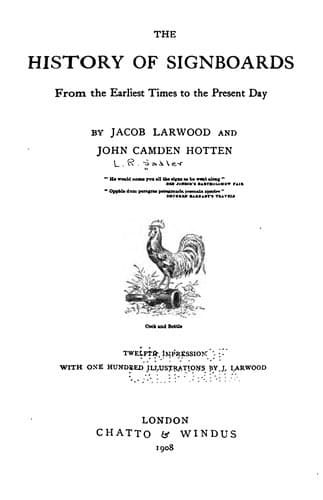
The History of Signboards, from the Earliest times to the Present DayHotten, John Camden
History
The History of Signboards, from the Earliest times to the Present Day
Hotten, John Camden
Inn signs -- England -- History; Signs and signboards -- History
The BULL, at Ware, obtained a celebrity by its enormous bed. Taylor, the
Water poet, in 1636 remarked, “Ware is a great thorowfare, and hath many
fair innes, with very large bedding, and one high and mighty Bed called
the _Great Bed of Ware_: a man may seeke all England over and not find a
married couple that can fill it.” Nares, in his “Glossary,” quotes
Chauncey’s, Hertfordshire; for a story of twelve married couple who,
laid together in the bed, each pair being so placed at the top and
bottom of the bed, that the head of one pair was at the feet of another.
Shakespeare alludes to it in “Twelfth Night,” where Sir Toby Belch in
his drunken humour advises Aguecheek to write: “as many lies as will lie
in this sheet of paper, though the sheet were big enough for the _Bed of
Ware_ in England,” (a. iii. s. 2.) Where the “high and mighty Bed” was
located, seems a mooted point; some say at the Bull, others at the
Crown, and Clutterbuck places it at the Saracen’s Head, where there is
or was a bed of some twelve feet square, in an Elizabethan style of
carved oak, but with the date 1463 painted on the back. Tradition says
that it was the bed of Warwick the king-maker, and was bought at a sale
of furniture at Ware Park. Recently it has been sold, and Charles
Dickens is now said to be its possessor.
The Bull Inn at Buckland, near Dover, deserves to be mentioned for its
comical caution to the customers:
“The Bull is tame so fear him not,
All the while you pay your shot.
When money’s gone, and credit’s bad,
It’s that which makes the Bull run mad.”
The famous OLD PIED BULL INN, Islington, was pulled down _circa_ 1827,
the house having existed from the time of Queen Elizabeth. The parlour
retained its original character to the last. There was a chimney-piece
containing Hope, Faith, and Charity, with a border of cherubims, fruit
and foliage, whilst the ceiling in stucco represented the five senses.
Sir Walter Raleigh is said to have been an inhabitant of this house.
“This conjecture is somewhat strengthened by the nature of the border
[in a stained glass window,] which was composed of seahorses,
mermaids, parrots, &c., forming a most appropriate allusion to the
character of Raleigh, as a great navigator, and discoverer of unknown
countries; and the bunch of green leaves [two seahorses supporting a
bunch of green leaves,] has been generally asserted to represent the
tobacco plant, of which he is said to have been the first importer
into this country.”[255]
At what time the house was converted into an inn does not appear. The
sign of the Pied Bull in stone relief, on the front towards the south,
bore the date 1730, which was probably the year this addition was made
to the building. That it was an inn in 1665, appears from the following
episode of the Plague-time:
Public-domain text, read in full here on John Shaqi.
Reviews
Reviews
No reviews yet
Be the first to share your thoughts on this work.
Elsewhere in the archive
Join the Discussion
Join the discussion
Sign in to leave a comment or review.
Sign InorCreate an account